

Are you a dark tourist? What is dark tourism? Here at Flying Fluskey we most certainly are dark tourists! That is why we are sharing (what we think are) the best dark tourism places around the world. But first:
(more…)Tag: South Korea
-
Entering Korea’s DMZ – A JSA, Imjingak and Third Tunnel Tour.
Whether you are a “dark tourist“, a patriot or just eternally curious, then this is for you; a day trip into the DMZ, where you actually get to step foot into North Korea.
This post may contain sponsored content or affiliate links that help support the blog. All opinions are our own.
The Morning
It was a very painful awakening when our alarms went off collectively at 06:00. Suddenly, a night of delicious sticky fried chicken and grapefruit soju didn’t seem like such a good plan (it was yummy though, read about it here). Four short, paranoid hours sleep didn’t equate to a happy morning. However, excitement was running high. This, our second day in Seoul, was the day of our tour north to the DMZ and North Korea.
We travelled to our pick up point, a subway stop on line 1 and prepared for tour bus roulette. Were we the first pick up; allowing us first choice of the seats but meaning we were an hour’s sleep short? Or were we last; allowing us more sleep but leaving us with separate seats or the middle back seat (surely the worst seat on a tour).
The lanyard we were given on the bus. “If lost, please return to…” Turns out we were the first to board the bus and so spent the next hour and a half going between guest houses and hotels slowly accumulating fellow DMZers before heading north towards the border.
An Introduction to the Korean War
At the end of WWII Korea underwent the same kind of division that affected Europe, with the Soviet Union occupying the Northern regions, and allied forces in the South. The line that split the country was called the 38th parallel. The onset of the Cold War meant the two sides failed to reunite as relations between the US and the USSR worsened and they both claimed they should possess the peninsular.
After two years of bloody skirmishes the North made a huge move to take control in 1950 and a three year war ensued. The Chinese backed North (also supported by the Soviet Union) almost won, but the newly formed United Nations (led by the USA) pushed them back. Eventually an armistice was signed in 1953 and the two countries have been in a state of stalemate ever since.
So What is the DMZ?
As part of the armistice, a new border was created, which unlike the 38th parallel wasn’t just a straight line. For two kilometres in either direction is the demilitarised zone (DMZ). This doesn’t mean there are no soldiers, but rather there is a strict agreement on the number of soldiers, weapons and where they may go.

A lookout post on the drive North Our Trip Begins
We drove North from Seoul towards the DMZ and our guide Lina introduced herself and the main story of the Korean conflict. Lina was a wonderful guide. She was bubbly and informative. As a young woman she doesn’t have personal memories of the war but she has still been affected.
Check out the latest price for the tour on seoulcitytour.net
Arriving at the DMZ
To enter into the DMZ, we had to cross the reunification bridge where we had to show our ID to a soldier. This was quite a casual exchange and so calmed any jingling nerves.

Driving across the bridge The Video
The bus pulled into a large car park and we were shown into a small cinema. It was propaganda time! I don’t know why, but I hadn’t expected it to be this way on the South side of the border but it was an excellent piece of film.

A loud American voice over listed atrocities committed along with dramatic music and fake explosion graphics. There was also a strange bit about how nature was flourishing in the DMZ and would “…forever, until reunification”. I know that they were trying to make it all seem less scary, and see the silver lining but we were probably a bit too cynical for it all.
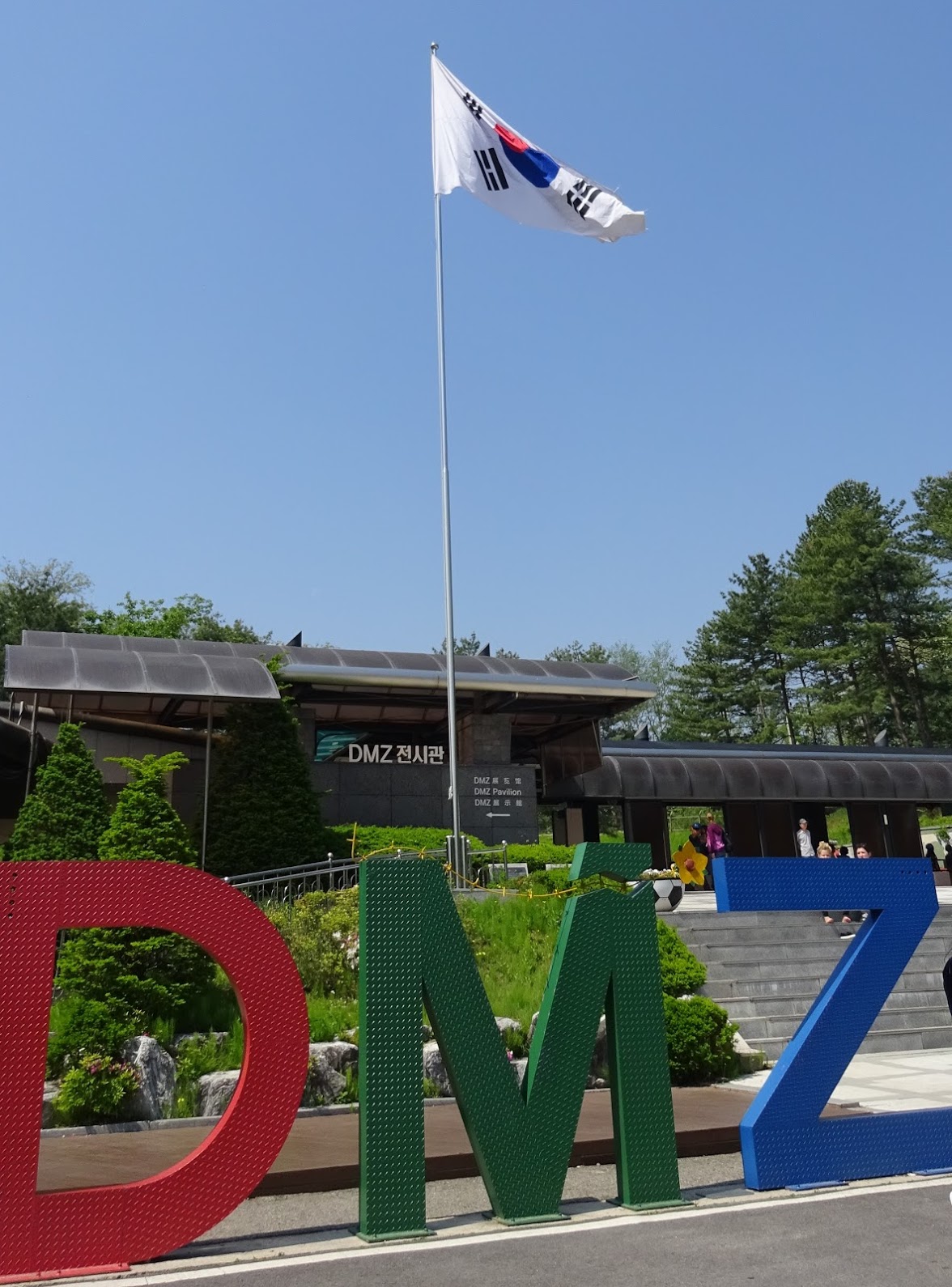
Next to the cinema was a collection of reunification statues and monuments. This was my favourite.
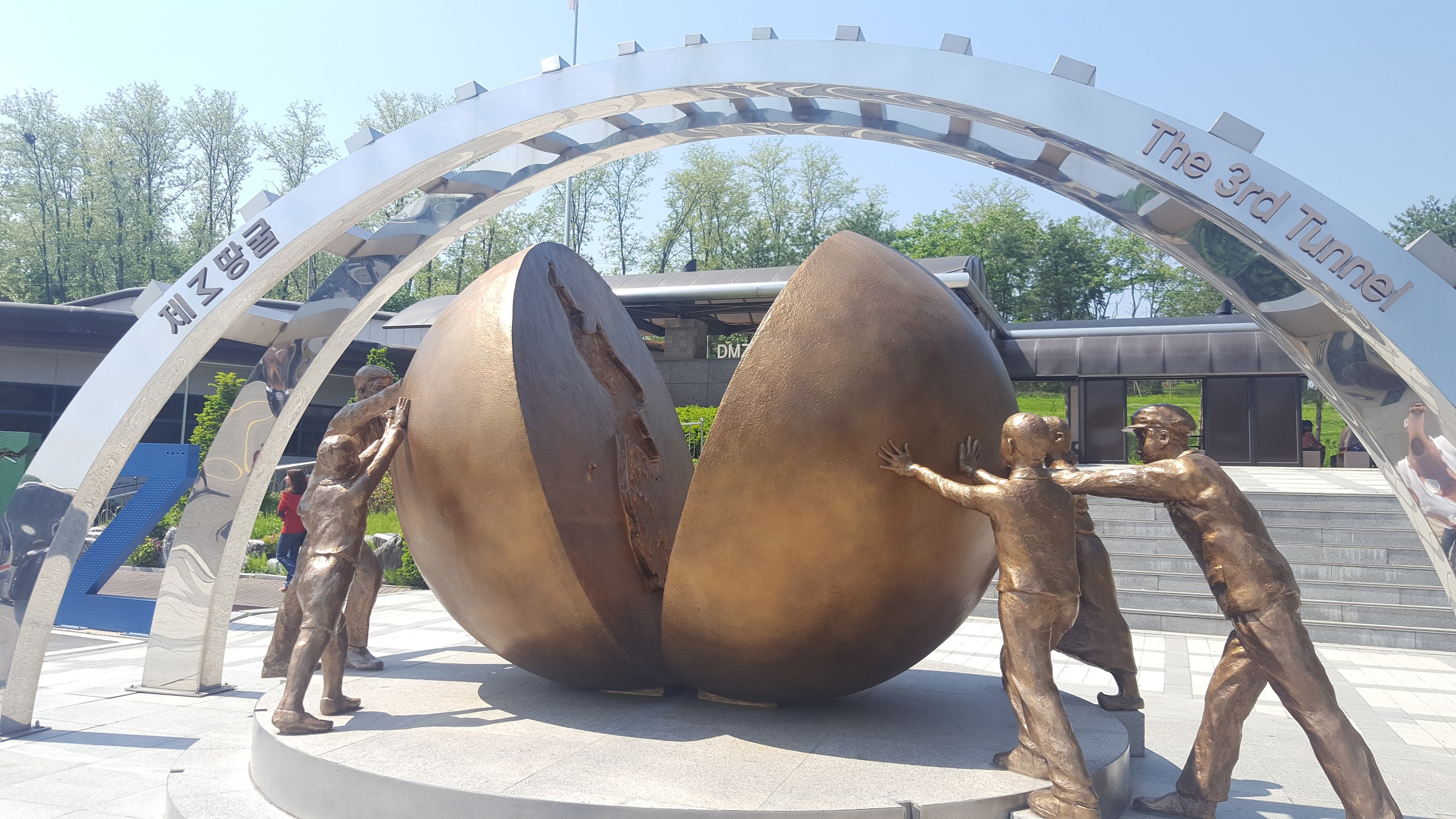
The Third Tunnel
Next we walked across the car park to “the third tunnel”. This is the third (duh!) of the infiltration tunnels that were discovered leading from North Korea into South Korea.
A defector from the North gave intelligence that these tunnels existed and investigations started from there. The North had been claiming that dynamite blasts had been for mining, and so the South decided to use the dynamite to their advantage. They dug 107 bore holes and filled them with water. The dynamite blast forced the water to erupt like a whale’s blow hole and this gave away the tunnels location. They dug an interception tunnel down to meet it, and it’s this that we now descended.

Our tour guide explaining the interception tunnel. You are not permitted to take anything down with you, so I have no photos from underground.

I DO have this awkward delight Check out the latest price for the tour on seoulcitytour.net
Down to The Third Tunnel
First you grab a couple of hard hats and then start the walk down. The tunnel descends at quite a steep angle and it’s only when you see people coming the opposite direction, puffing and red faced, that you start to wonder how far down you’re going. It’s 350m down, enough to make you slightly wobbly legged.
Once you are down there you can see the bore hole and then you are instructed to go down the infiltration tunnel itself. The walls here are much rougher and it’s a much tighter squeeze, but scaffolding and a floor have been constructed to make it easier. Karl and I aren’t the tallest human beings, but even we occasionally bumped our heads. Suddenly the hard hats made sense. Taller people were constantly banging their helmets against the ceiling. At the end of this section you can peer through one barrier, and to the next. There are three in total so that’s almost a glimpse into the North.
Dora Observation Point
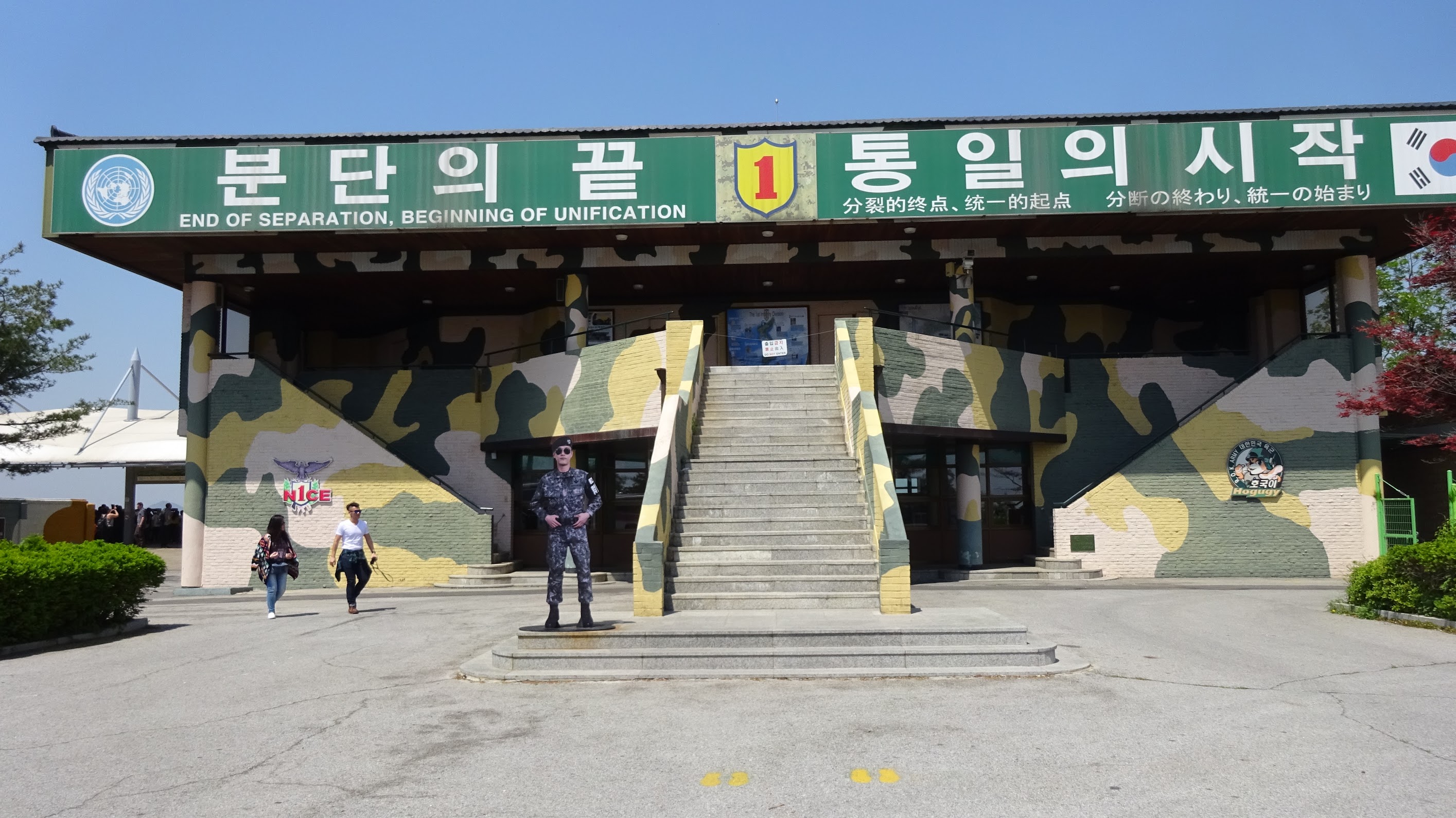
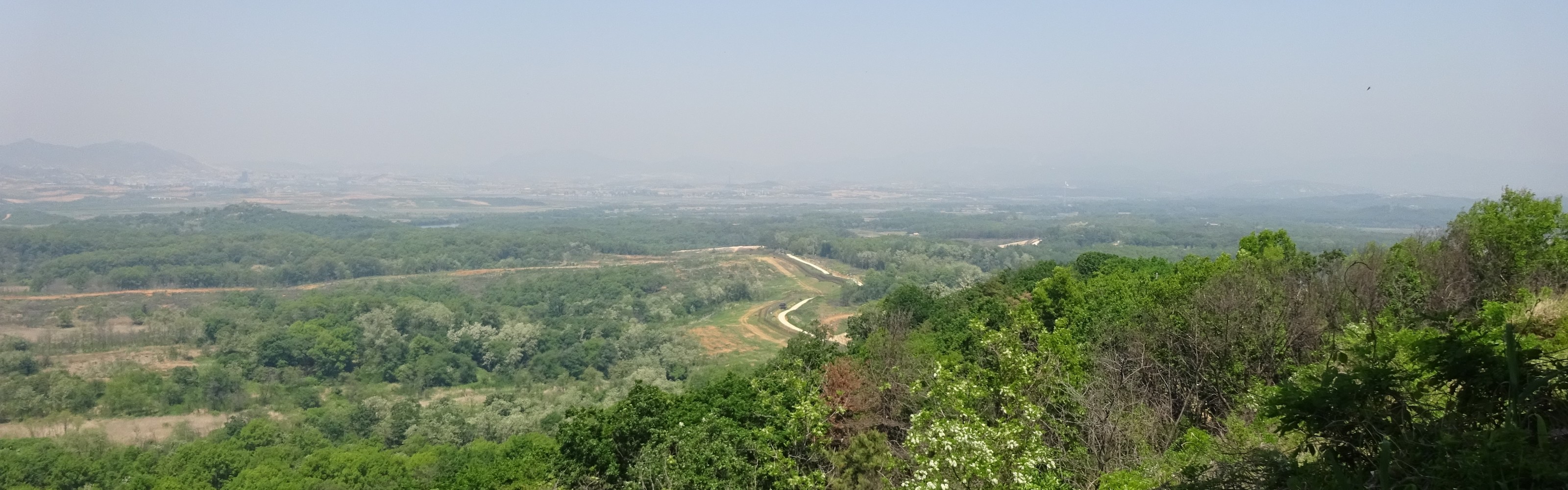
Your next view of North Korea is a short bus ride away. There is one observation point open to the public. Here you can gaze across the DMZ and catch sight of not only the propaganda villages (more on those in a moment) but also the city of Kaesong.

The city of Kaesong in North Korea 
Both countries try and top the height of the others flag pole. Here is North Korea’s. 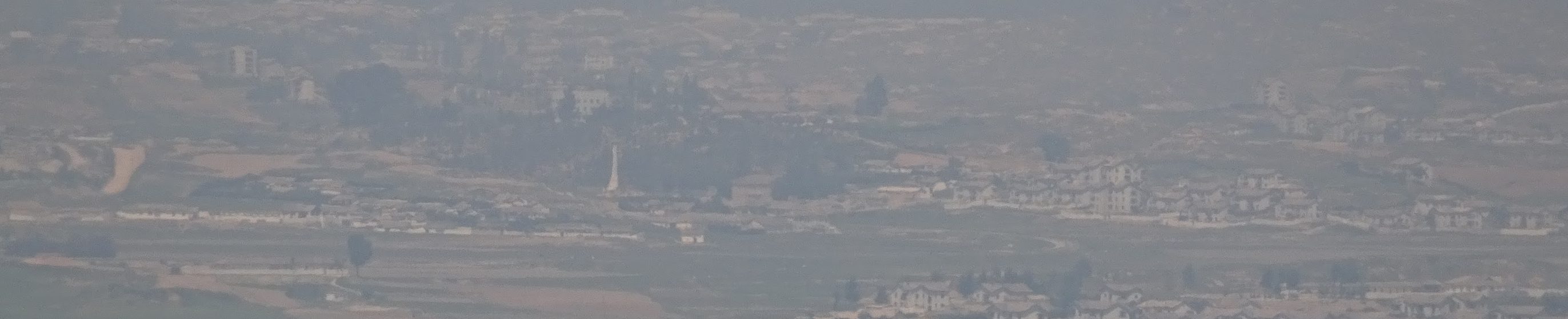
Apparently there is a statue of one of North Korea’s leaders far in the distance, but only the eagle-eyed will see that. If you haven’t brought your own binoculars, don’t panic, there are coin operated versions (like you see at the British seaside).
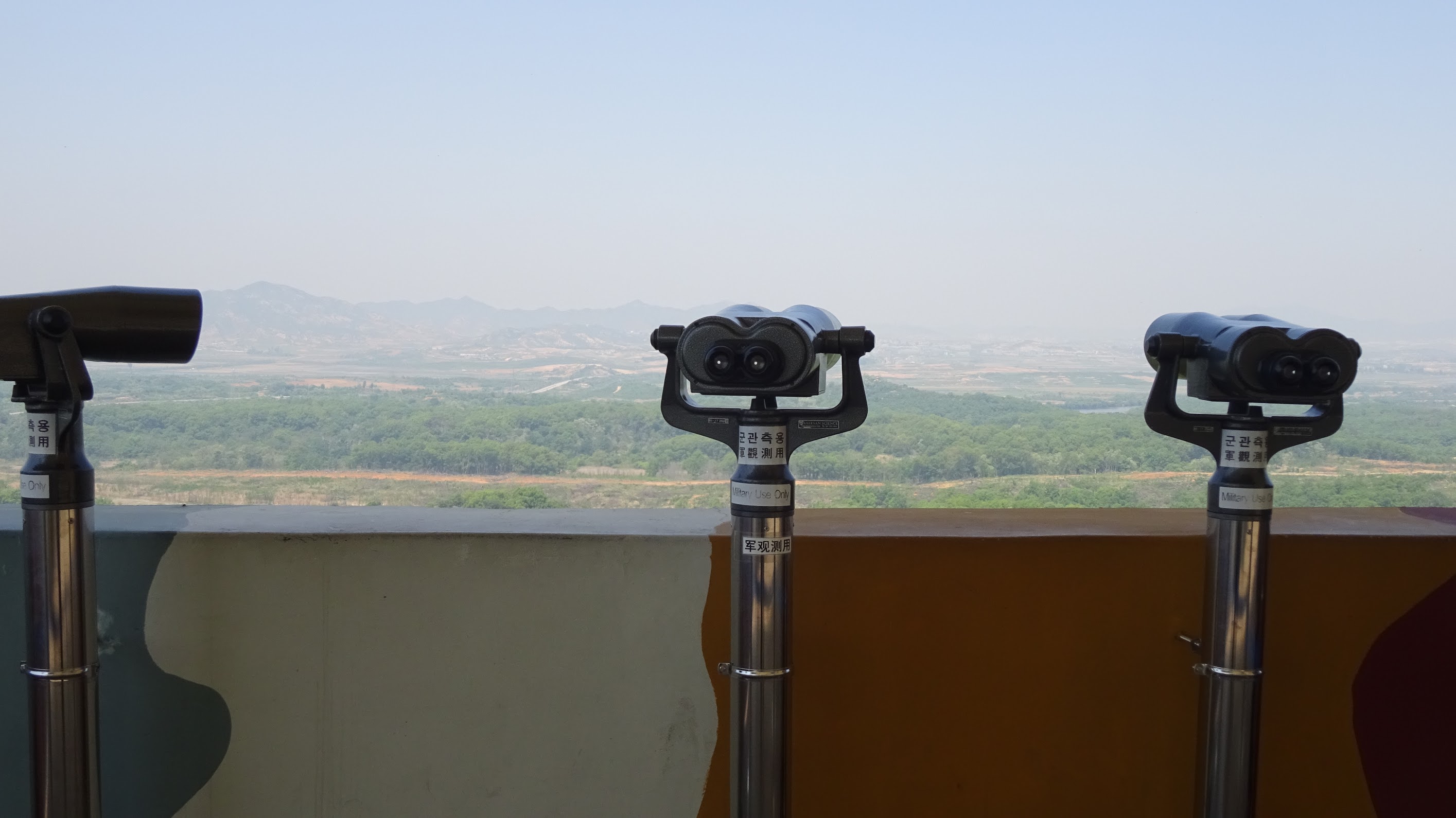
It’s a very noisy place to stand. Several times a day, the North Koreans will play their propaganda broadcasts. These usually include traditional music and praise for the supreme leader, Kim Jong-un. In return, South Korea belts out a local radio station full of K-Pop and overly enthusiastic, seemingly hilarious DJs. We struggled to hear the North Korean patriotism but the wind was on South Korea’s side and it was carried away on the breeze.

The propaganda sound system Read about all our travels in South Korea
The Villages
As well as propaganda broadcasting, each side has what is known as a propaganda village. Farmers live and work in the DMZ, but only in these two designated spots. On the South Korean side, to apply to live there, you must:
- have ancestors come from the area.
- spend eight months of the year here.
- stick to the paths that have been cleared, to avoid land mines.
- be accompanied by a UN soldier whenever you are out.
- never communicate in any way with the North Koreans (even when they are farming just metres from you)
So why would you want to live here? As well as reclaiming your family’s lost land, the residents pay zero tax. It must be an incredibly strange life with propaganda blaring over your lunch and a curfew in place every night.
Dorasan Train Station
In the 1990s, a policy called the sunshine policy improved relations with the North so much that they started doing business together. KIC (Kaesong Industrial Company) traded goods with the South through the DMZ. In 2008, a fancy new train station opened to help with exchange of goods, and a train line opened North to Pyongyang, North Korea’s capital.

However, in 2008, a South Korean tourist was shot when she wandered into a restricted zone and the ties between the two sides worsened significantly. All trade halted and the station was shut.
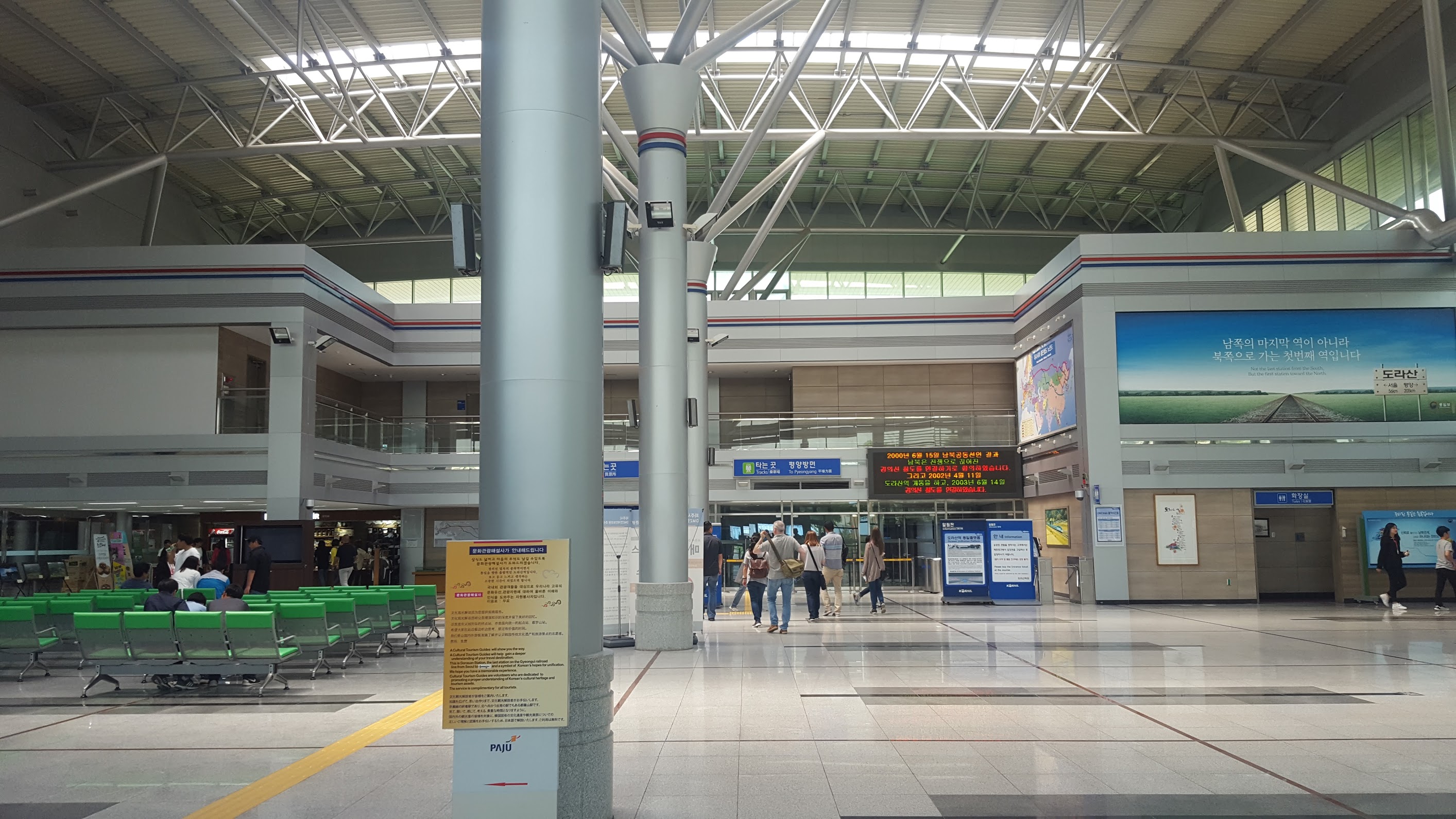
It is now empty of all train traffic North. The place looks like a film set; shiny unused customs points and an unused ticket desk. You can stamp something with North Korean border stamps and purchase a ticket to stand on the Pyongyang platform.

There was once grand plans to join South and North Korea up to international train routes. In one corner there is a souvenir shop and one thing caught my eye. They are selling wild grape wine from North Korea. This is one of the only places to purchase anything from North Korea and so I was sorely tempted. When I picked up the bottle, however, it was full of sediment and Mr Fluskey gave me such a disapproving look, that I put it down again.
Check out the latest price for the tour on seoulcitytour.net

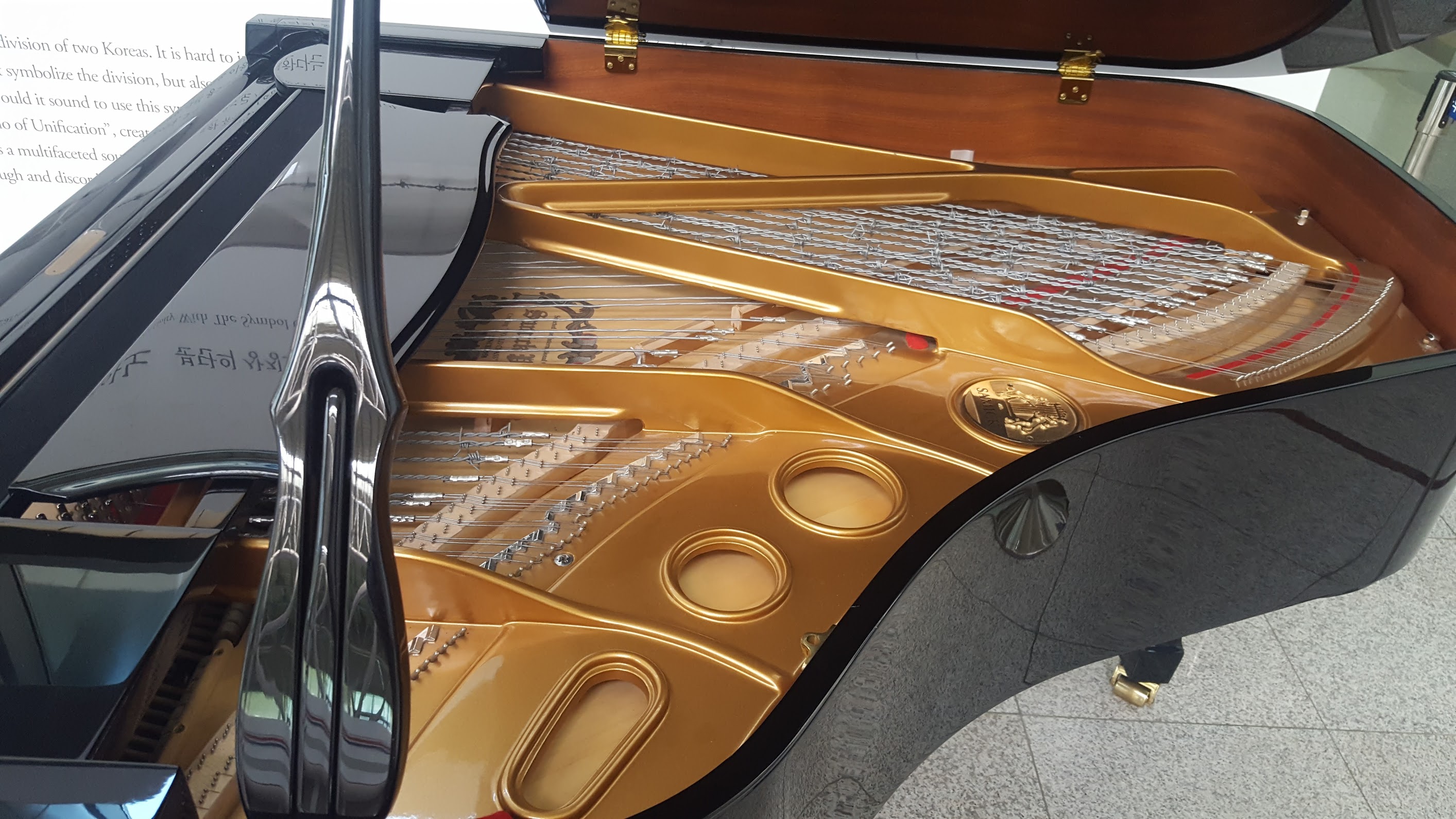
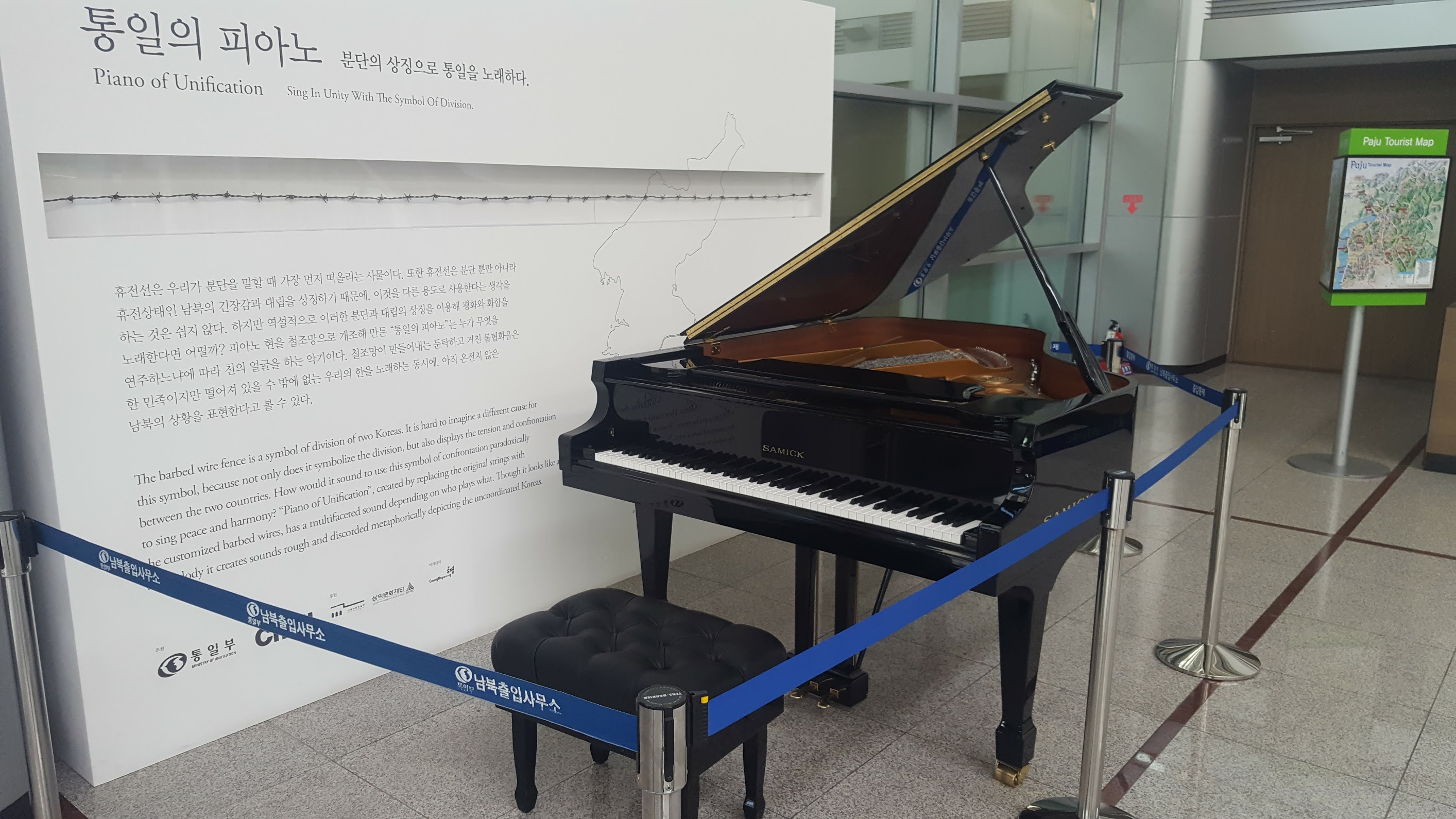
Opposite the shop stood a grand piano. The strings had all been replaced by barbed wire to represented the discordant relationship between the Korea’s. We stood reverently behind the ropes but our tour guide bounded up and merrily thudded on the keys for us to hear.
Imjingak Park
This is where things got really surreal. There had been an atmosphere of slight solemnity over the tourists despite their excitement, but here, things are so mixed up. Not only are there monuments but exhibitions, restaurants and a fun fair!? Apparently it is sometimes called the Imjingak resort, and you can see why. This is where dark tourism becomes mass tourism. The whole thing was built in the 1970s. It is the furthest North that South Korean’s can travel legally.

After a delicious lunch of bulgogi (you can read about it here) we took a look around. We started by exploring the park full of monuments.
The Park
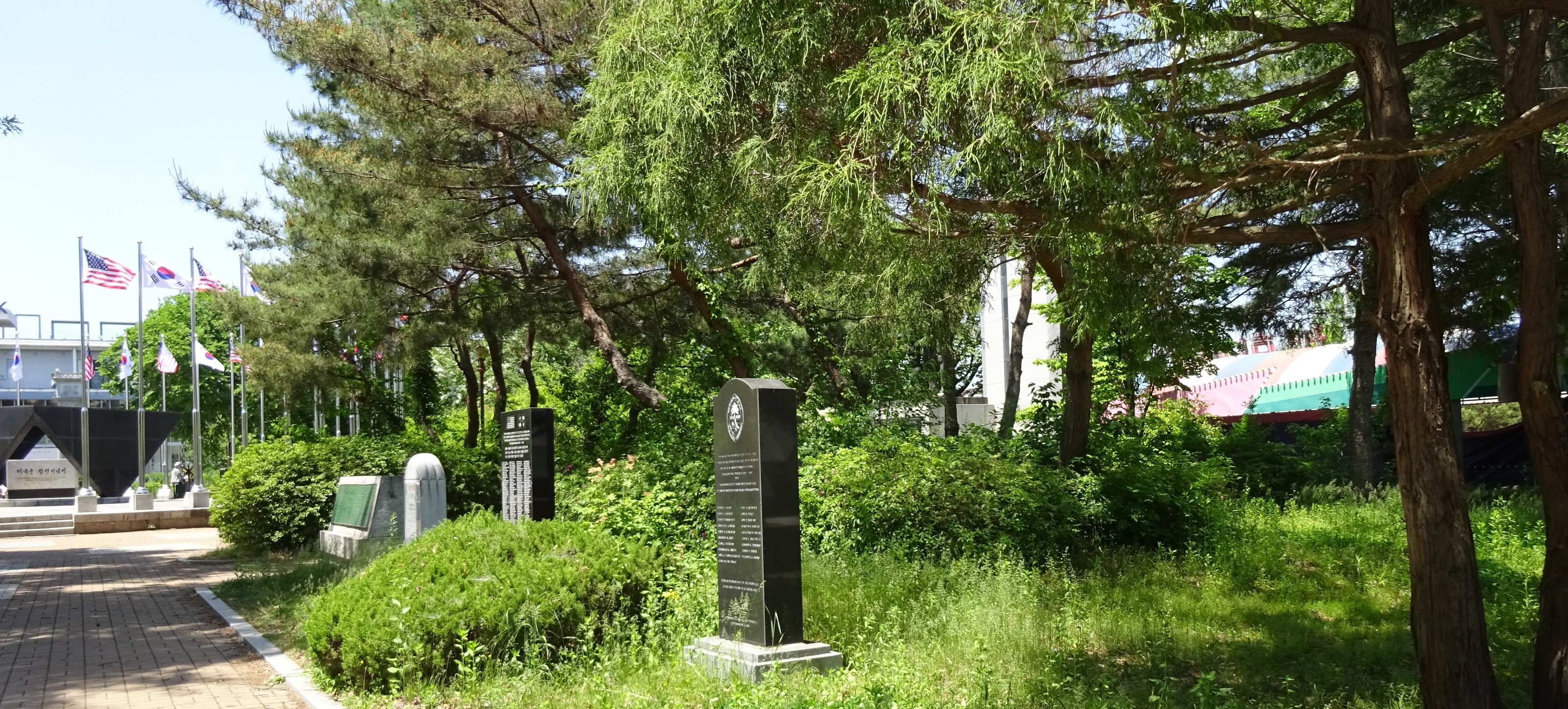
A collection of memorials around a small park commemorating those that were lost during the conflict. These range from small tablet style monuments to these huge statues.


The Roof Terrace
Back around to the main building and we went to the roof for the view. It is up on the third floor and from here you can see across the whole resort. It has all been decked to make it easier to get around and the views are superb.
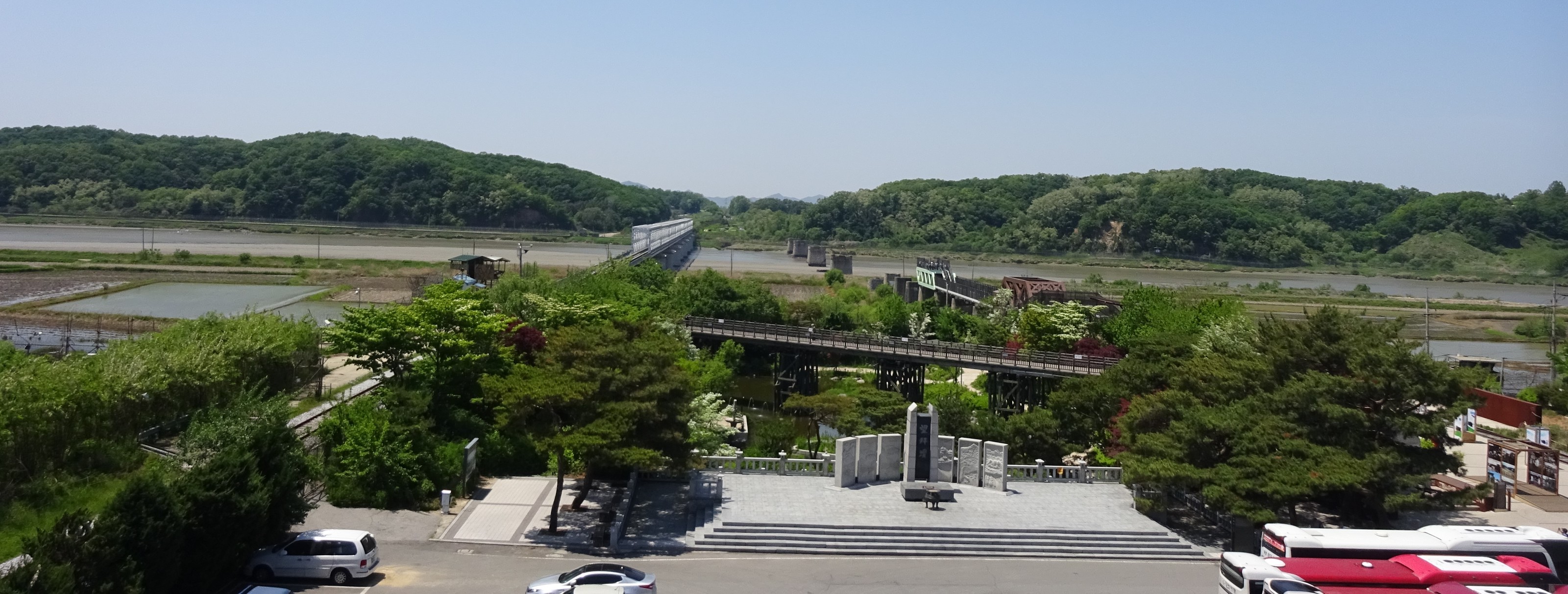
Mangbaedda Alter (The Peace Monument)
Cross the car park and you arrive at the main monument for those who have been separated. Every New Year’s Day and Korean Thanksgiving (Chuseok), it is thronged by those who come to commemorate their loved ones. They are able to bow towards the North for their lost family, their ancestors and home towns.
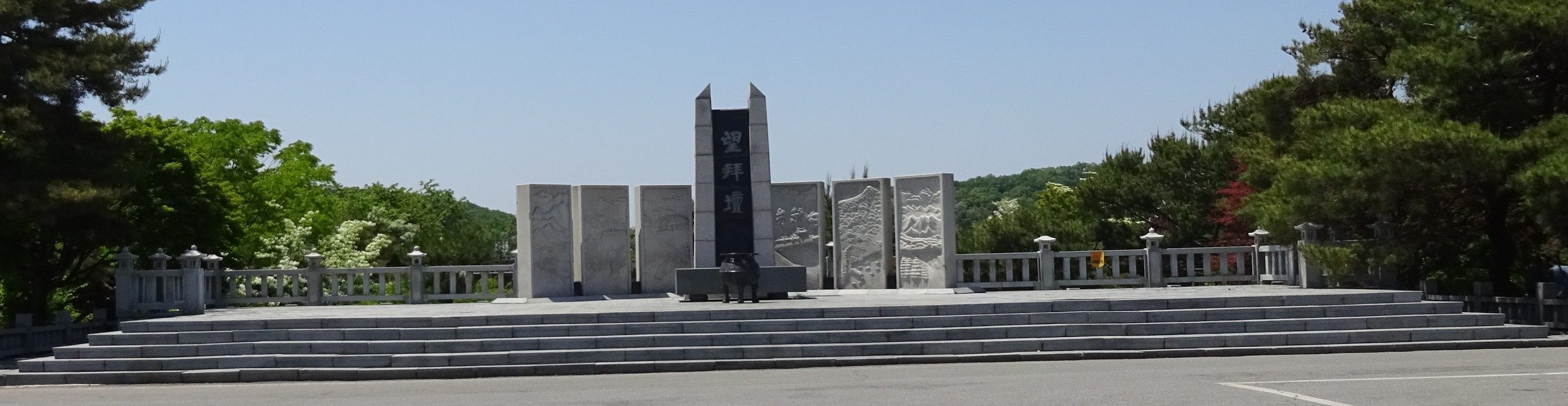
The Bridge of Freedom
This bridge played a large part in the armistice agreements. Thousands of prisoners of war were traded across it. In fact, this foot bridge was built expressly for that purpose, all other land being dangerous and the bridges long destroyed during the war. These POWs walked home.
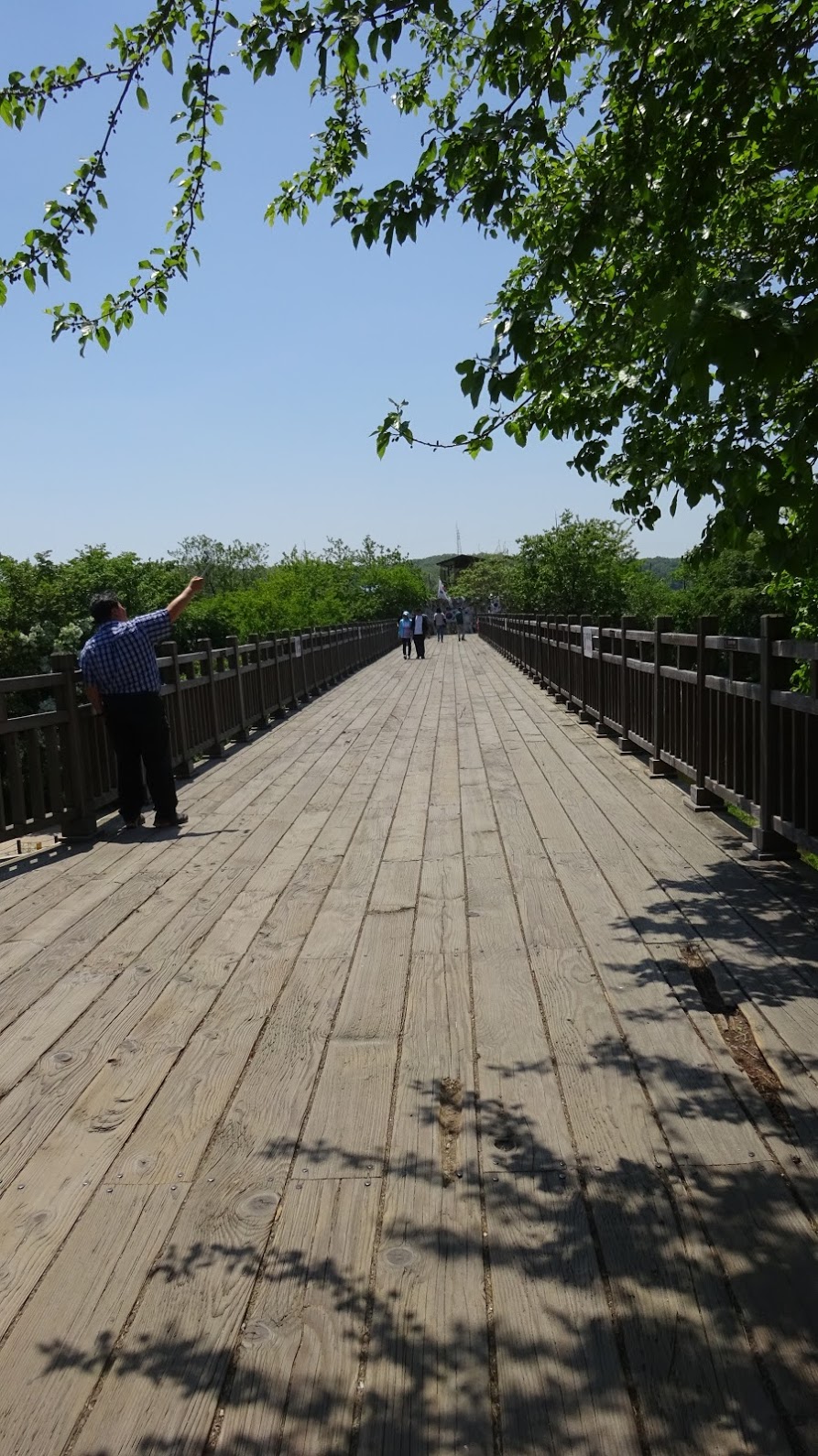
We also stopped to look at the brightly coloured ribbons fluttering on the barbed wire fence opposite. These are placed by those who have their ancestral family in the North and they display wishes, hopes and prayers. The rainbow of colour belies what a moving tribute this is.
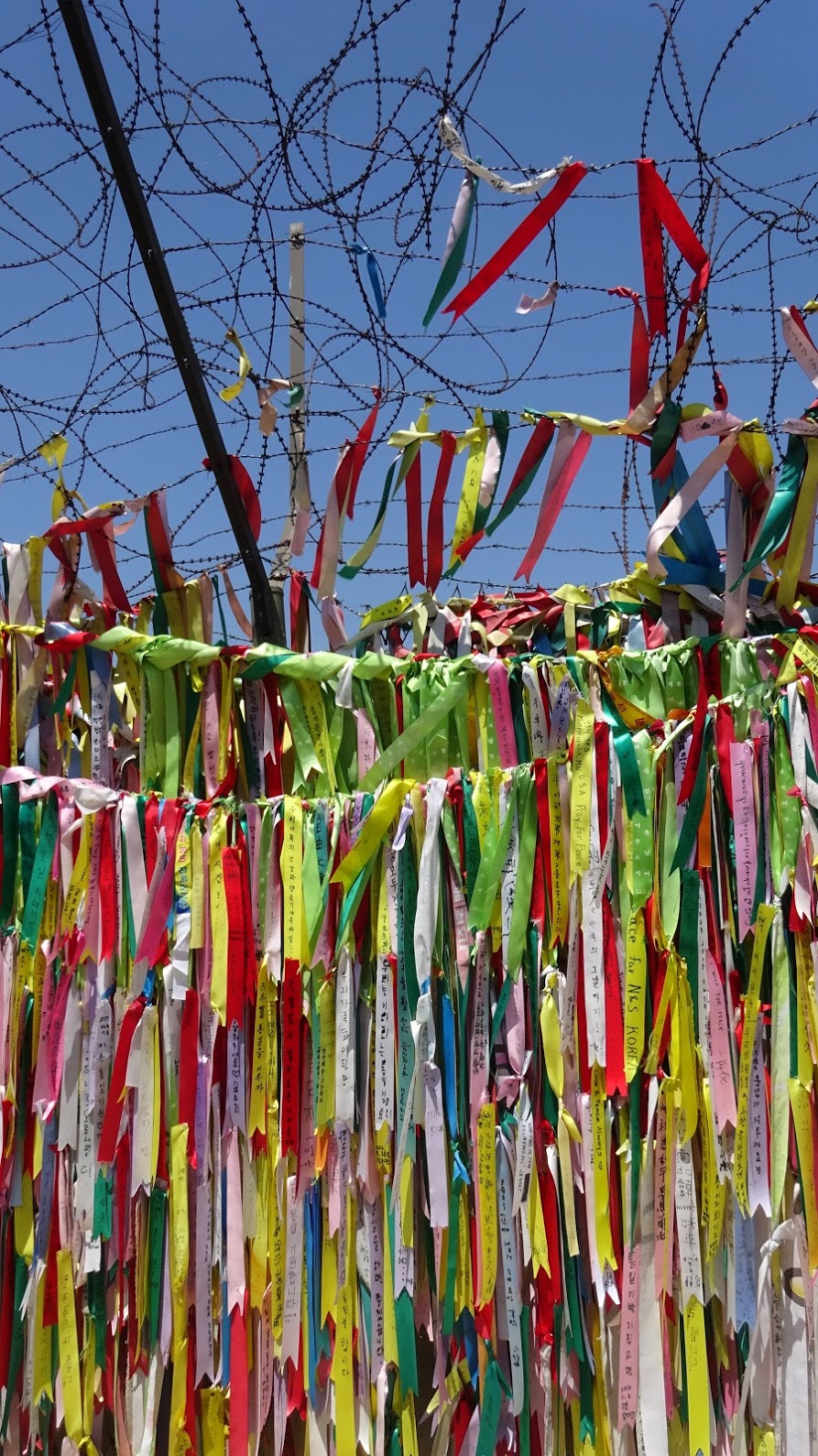
The Train
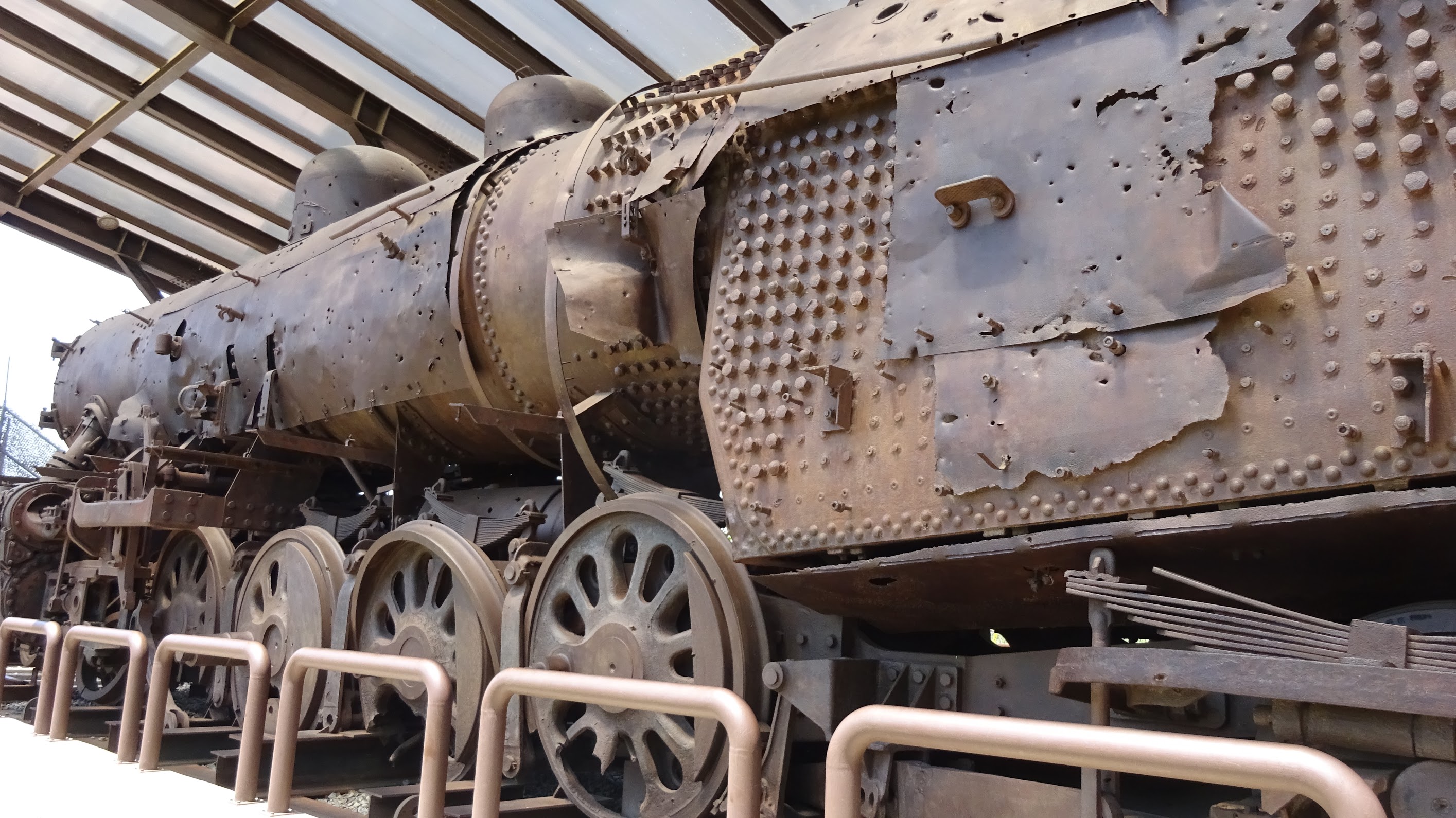
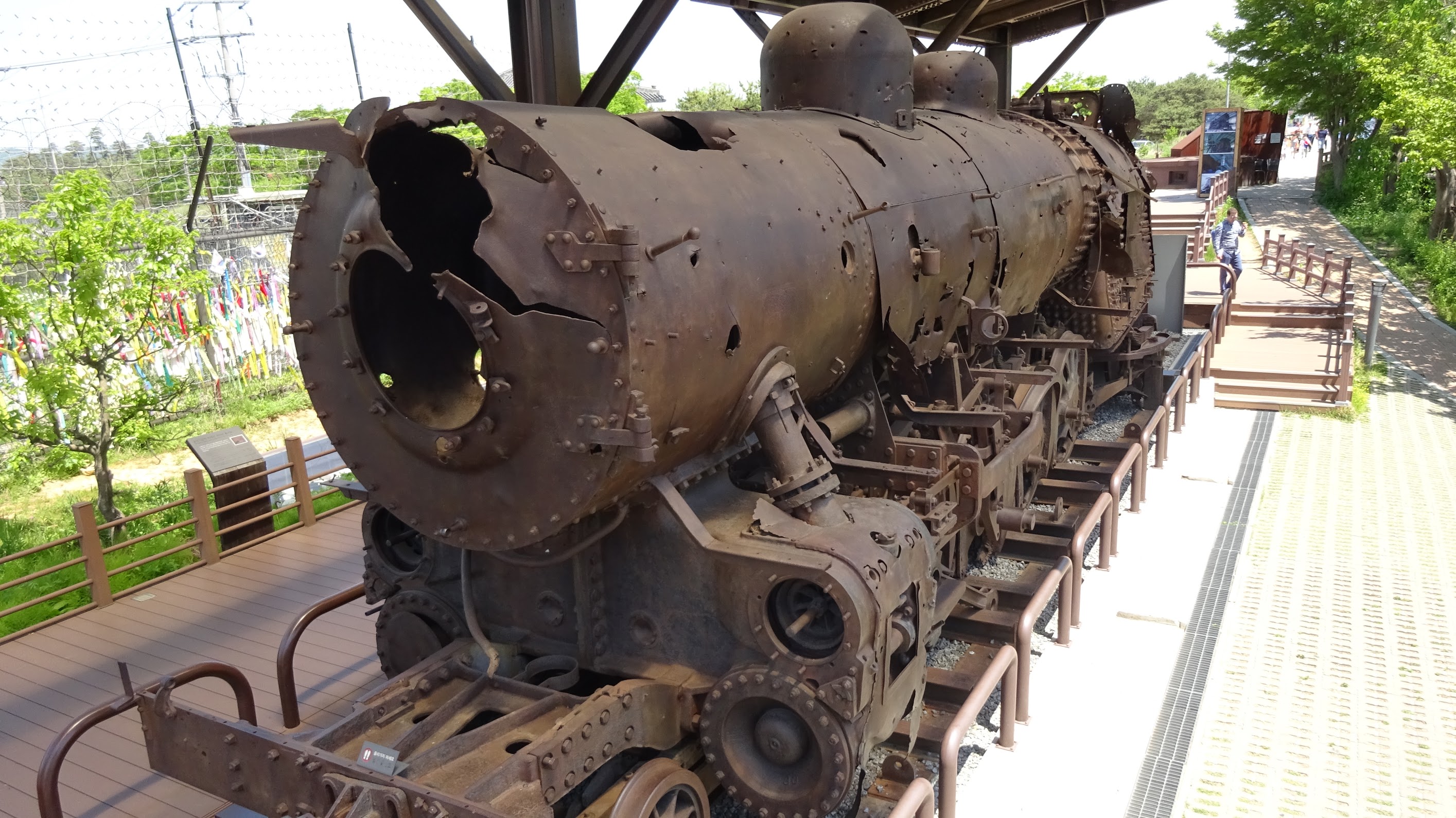
Next to the park we had seen a train engine. We were astonished at the restoration work that they had done. We had read that the engine was riddled with bullet holes and left to rust…turns out it was the wrong one!

DOH! Just North of the bridge of freedom sits the actual train. It is pockmarked with hundreds of bullet holes and shell marks. It is on display to demonstrate the horror of war. I find it amazing to think that people underwent that kind of barrage on a daily basis.
Check out the latest price for the tour on seoulcitytour.net
Other Sights
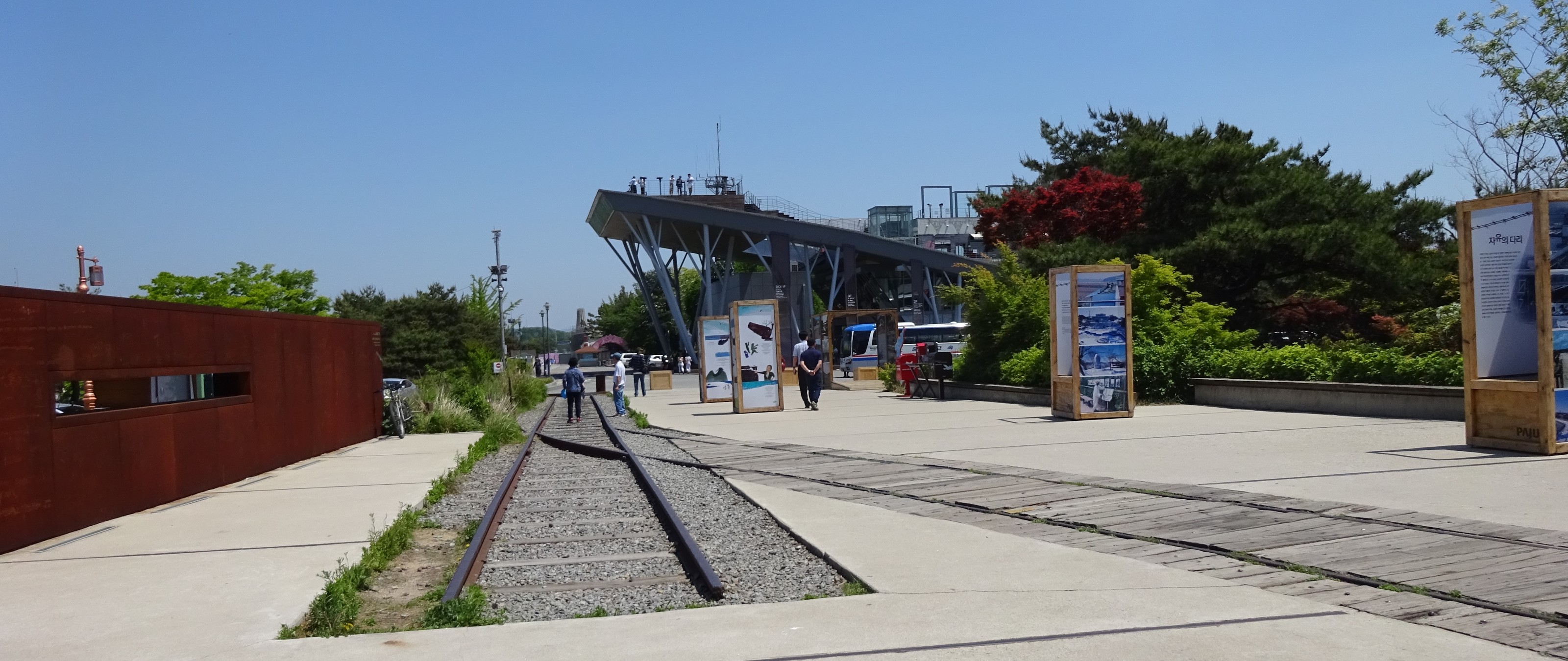
As well as this, they are extending the old railway bridge out over the valley so you can walk across towards the North (this costs £2.50/$3 more). There were also a few more exhibitions, one of war photos and one about the proliferation of nature in the DMZ.
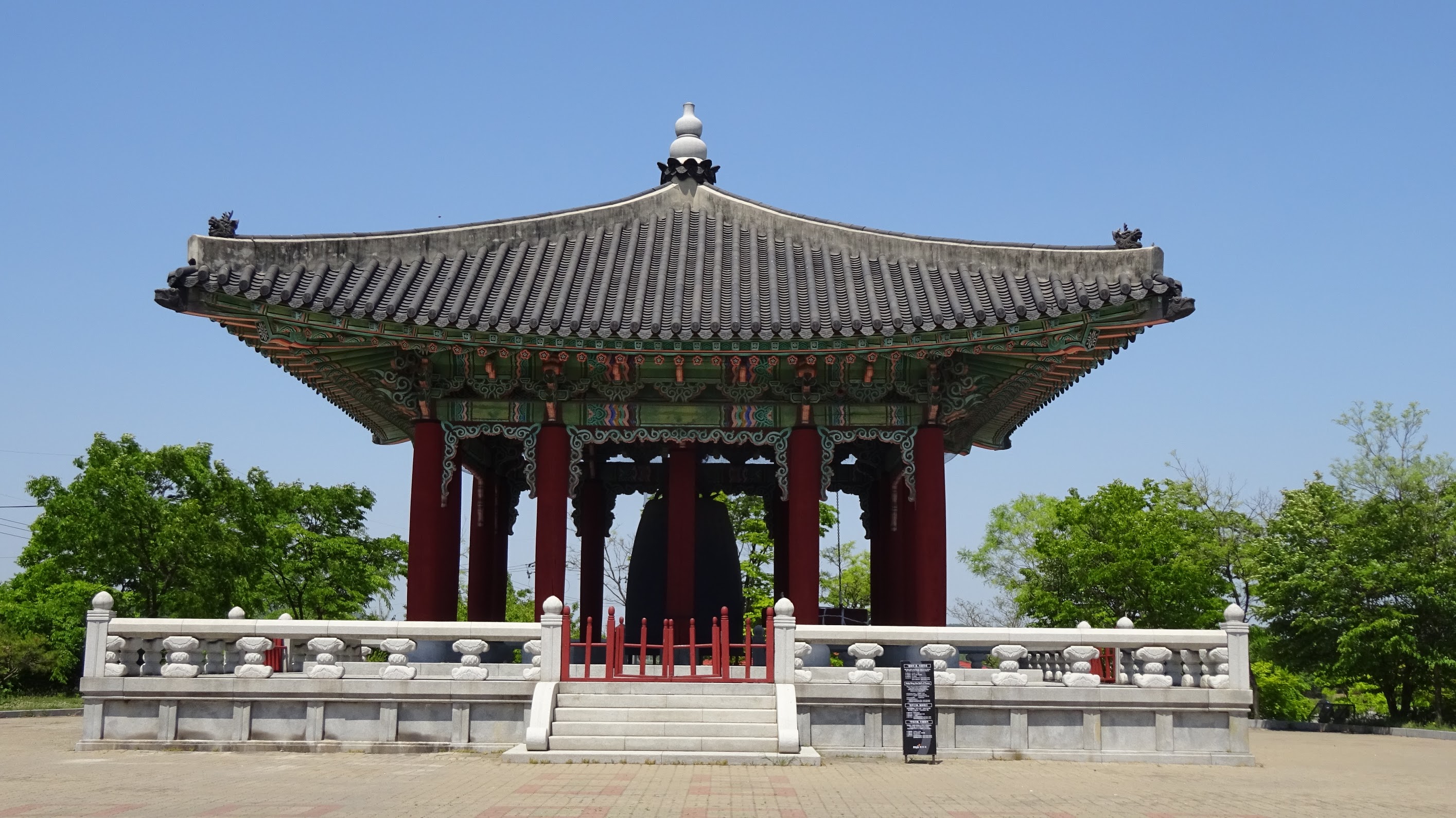
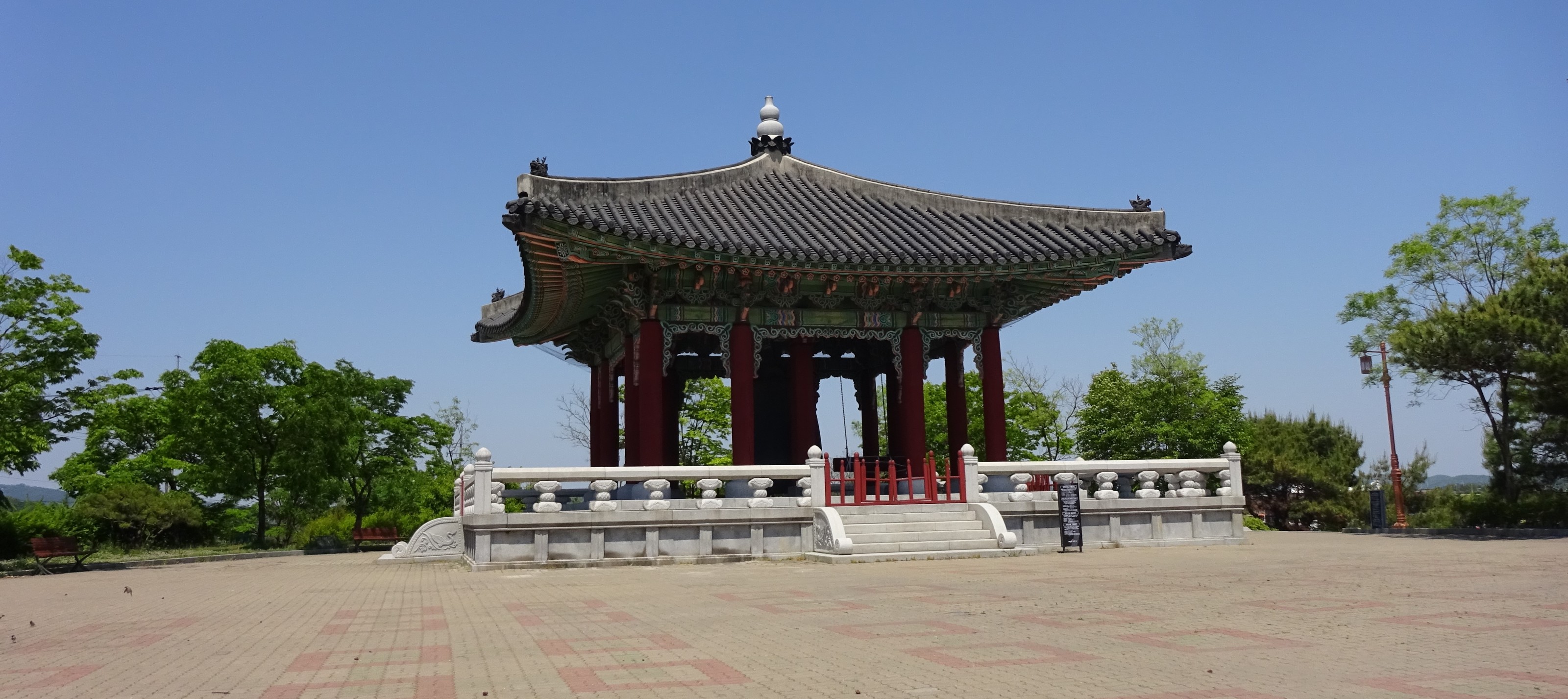
Just around the corner is a temple, a spot to sit and contemplate, away from the crowds.
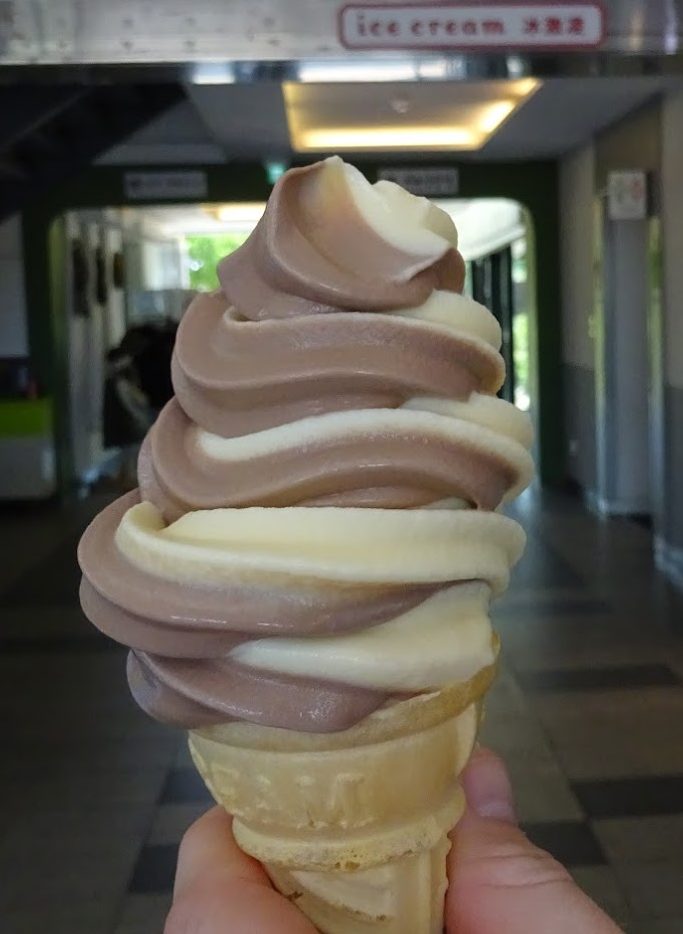
We enjoyed wandering around, and even found time for some dessert, before it was time to make our way to our new coach.
During lunch we had all been given a seat number for what we will call the breakaway coach. Some people were heading back to Seoul and so these coaches were a combination of all the tour groups that had descended upon Imjingak. After a quick toilet stop, we boarded the breakaway coach and took our assigned seats.

Camp Boniface
The soldiers who work in and around the DMZ are all taller than the average South Korean (they must be over 5’6″) have excellent spoken English and are awfully handsome. According to Wikipedia, they must also be a black belt in taekwondo or judo but I can’t confirm that as I didn’t get a chance to ask. This is not only to impress impressionable lady tourists but is another weapon in the propaganda arsenal.

We were welcomed to the camp by a very good looking young soldier with a strong American accent. It was time for another film. This one served a nice dollop of bias but also took us through the rules of entering the JSA.
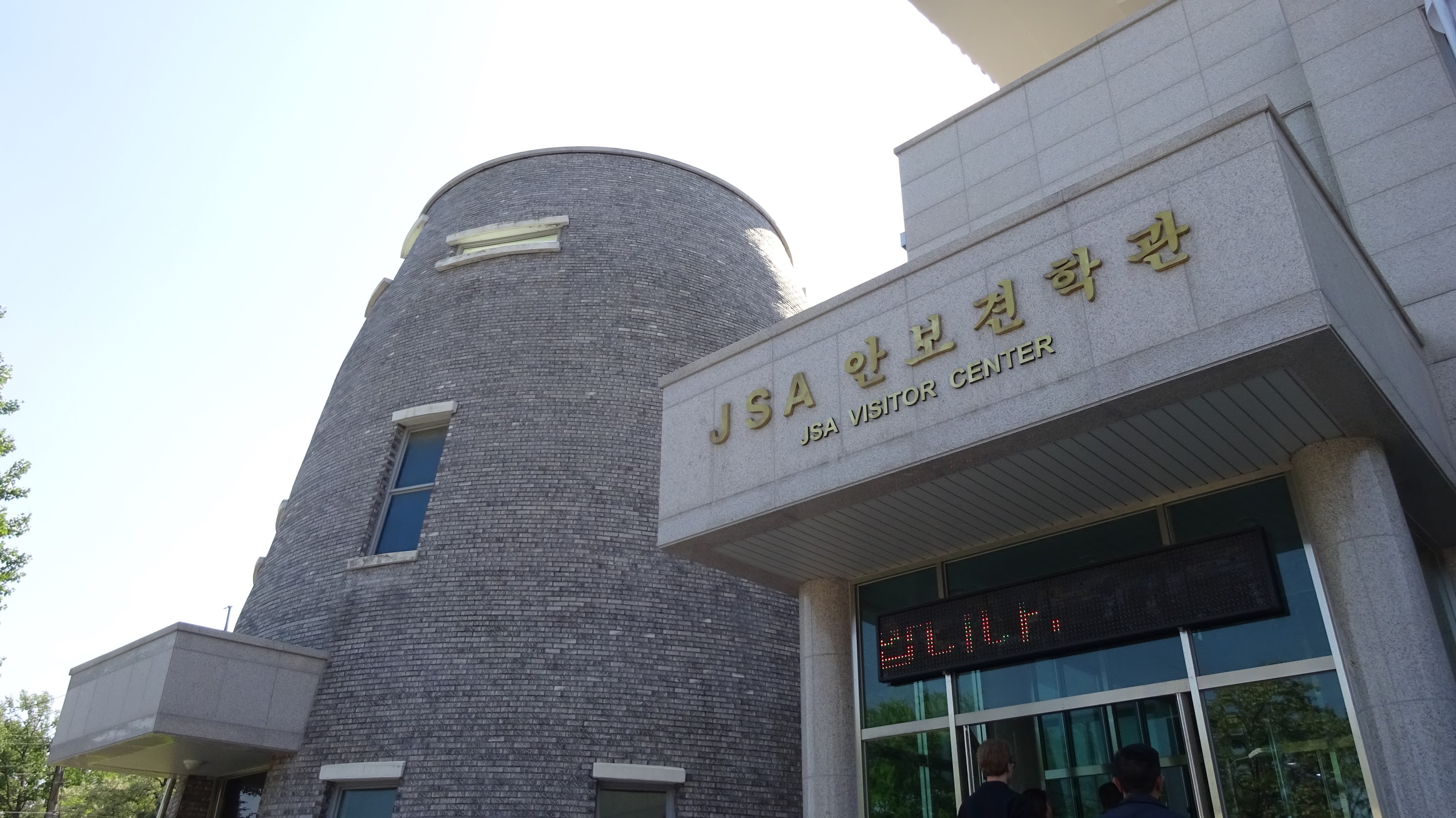
Basically, follow instructions, wear clothes that cover you up and don’t even THINK of communicating with anyone on the other side. We all signed waivers to the effect that if we were shot, it was our own fault and then it was time to jump onto two new coaches. On the breakaway coach, we had all been screened and had our passports thoroughly checked. Everyone had to leave their bags on the breakaway coach and now we boarded two new coaches ready to drive into the JSA.
Entering The Joint Security Area
As we drove through yet another checkpoint the atmosphere on the coach got more excitable. People craned their necks to see the land around us. We drove past tank defences and a frisson shuddered through the tourists. In the distance you could see South Korea’s propaganda village.
My early morning caught up with me and my head dropped to my chest. I missed the rest of the five minute drive.
Check out the latest price for the tour on seoulcitytour.net
The JSA Main Spot
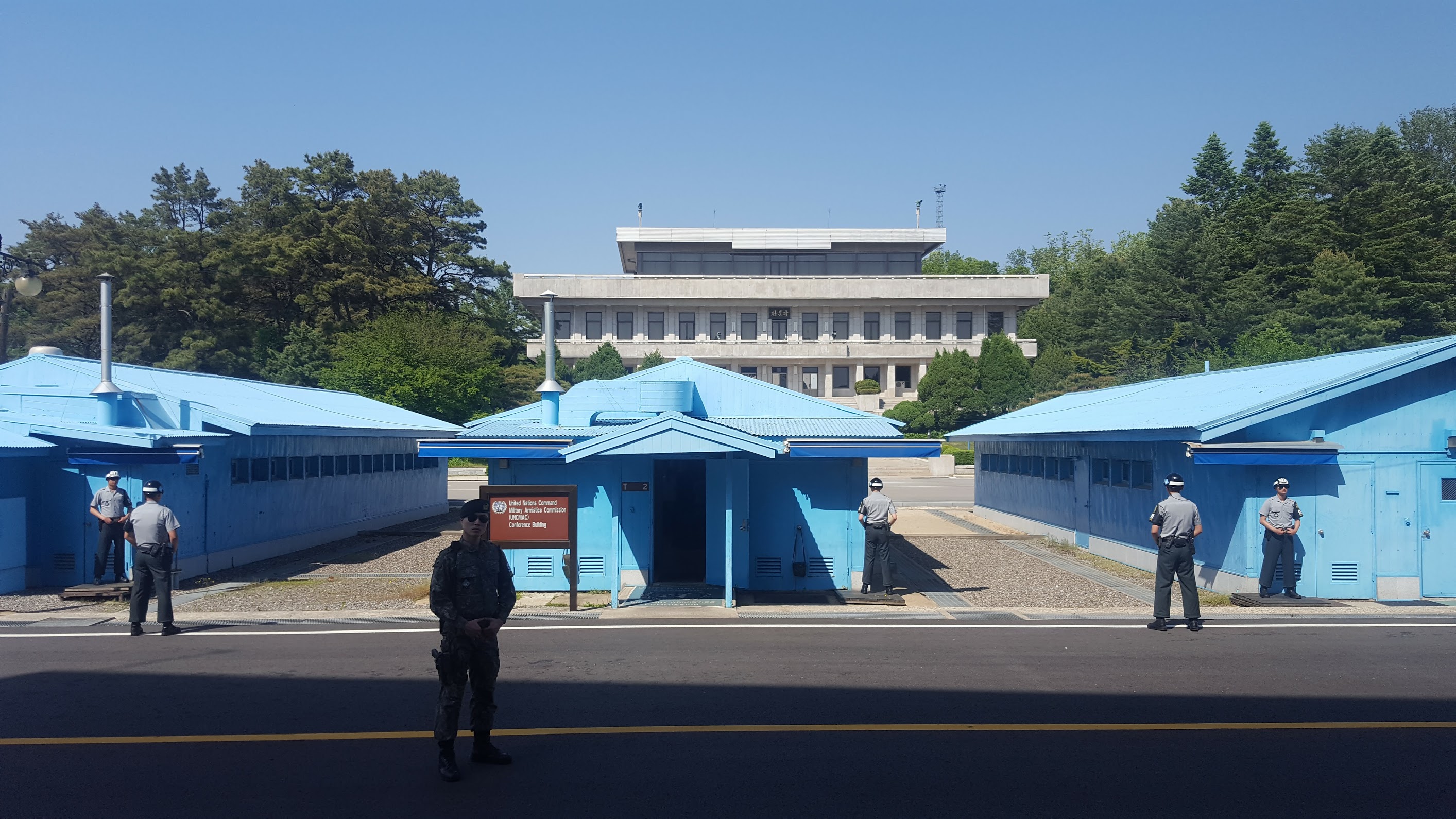
When we arrived the two coaches formed two lines and we walked single file behind our guide. One half was to spend five minutes on two steps outside South Korea’s building facing North Korea’s whilst the rest of us entered the central blue hut, the Military Armistice Conference Room. There are five huts, three blue and two white. The blue ones are maintained by South Korea and the white ones by the North. The central one is the only one that the public can enter and you can do so on a tour from the South or the North.
The JSA used to be an entirely neutral area, but in the 1970s, two American military personal were killed. After this, the Military Demarcation Line was drawn through the middle. This goes through the buildings where negotiations are held. Each hut has line markers through it, even going along the middle of the meeting tables.

It looks a little unimpressive, but this is the line. Photo Time
We were informed there was a strict five minute time limit. We entered and spent a little time wandering the line between South and North Korea. It’s the only point where you can cross this line. It was a teeny bit thrilling. We took a super awkward photo with the UN guards who stand guard in front of the door out to the North’s side of the JSA. We were back of the queue for photos and the guard was insisting that five minutes were up. Pushing our luck maybe!?

The door to North Korea behind us! 
My “please don’t tell me off” face! We then had our five minutes outside. The group was not allowed to take a photo of the large South Korean building we were stood in front of, or to the left and right of the watch towers, only North to the building opposite.
Mr Fluskey and I were at the end of the line and so were in the wrong spot to catch a photo of the one North Korean guard on show. Our military guide informed us that they nickname him Bob. That’s my go-to nickname too! If you want to get a shot of Bob, place yourself to the centre or the right of the steps when it’s your- turn for the photo session.
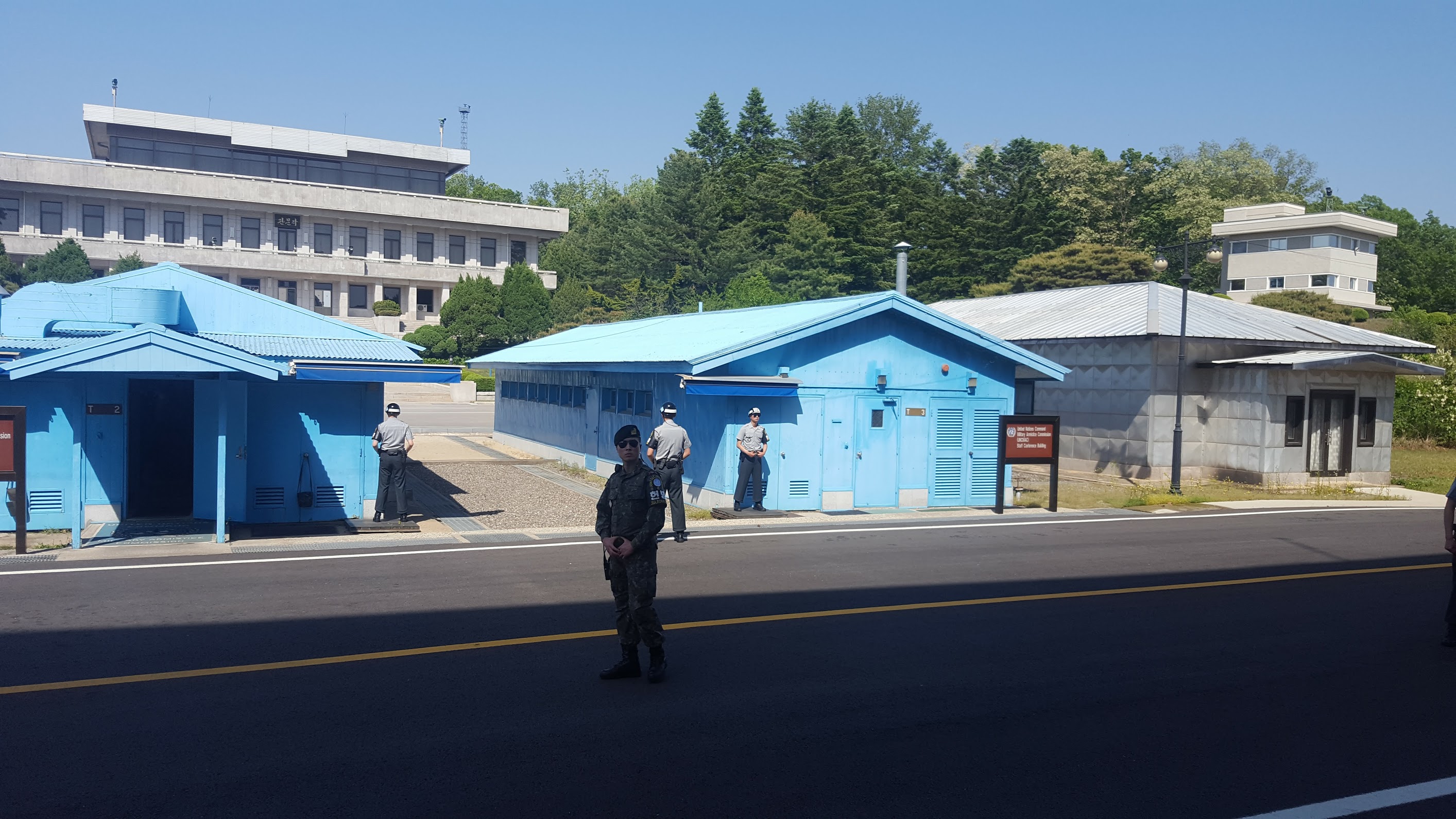
I was surprised not see any American soldiers here but found out that it has been run by the South Korean’s alone since 2004.
Back to the Visitor Centre
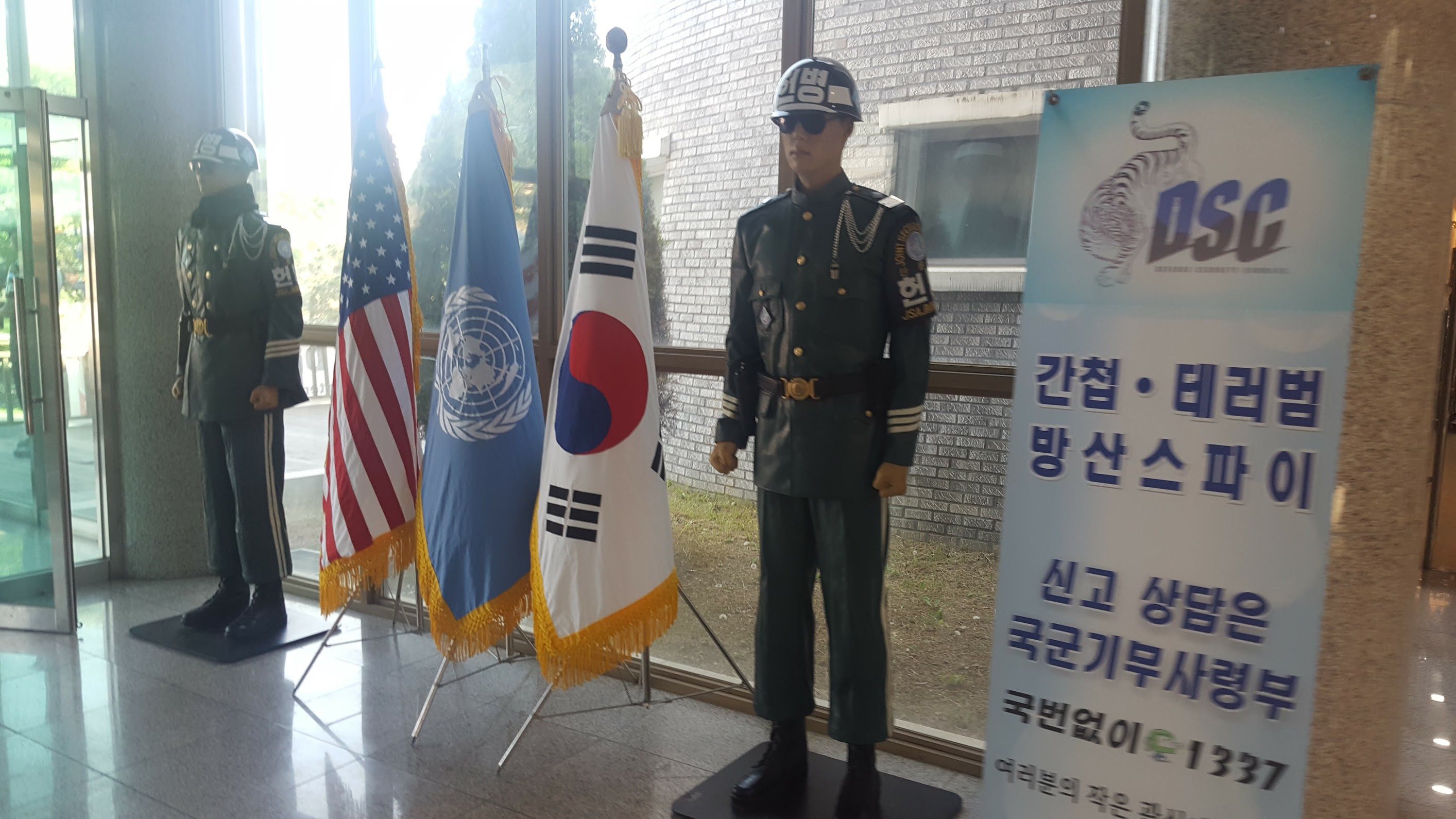
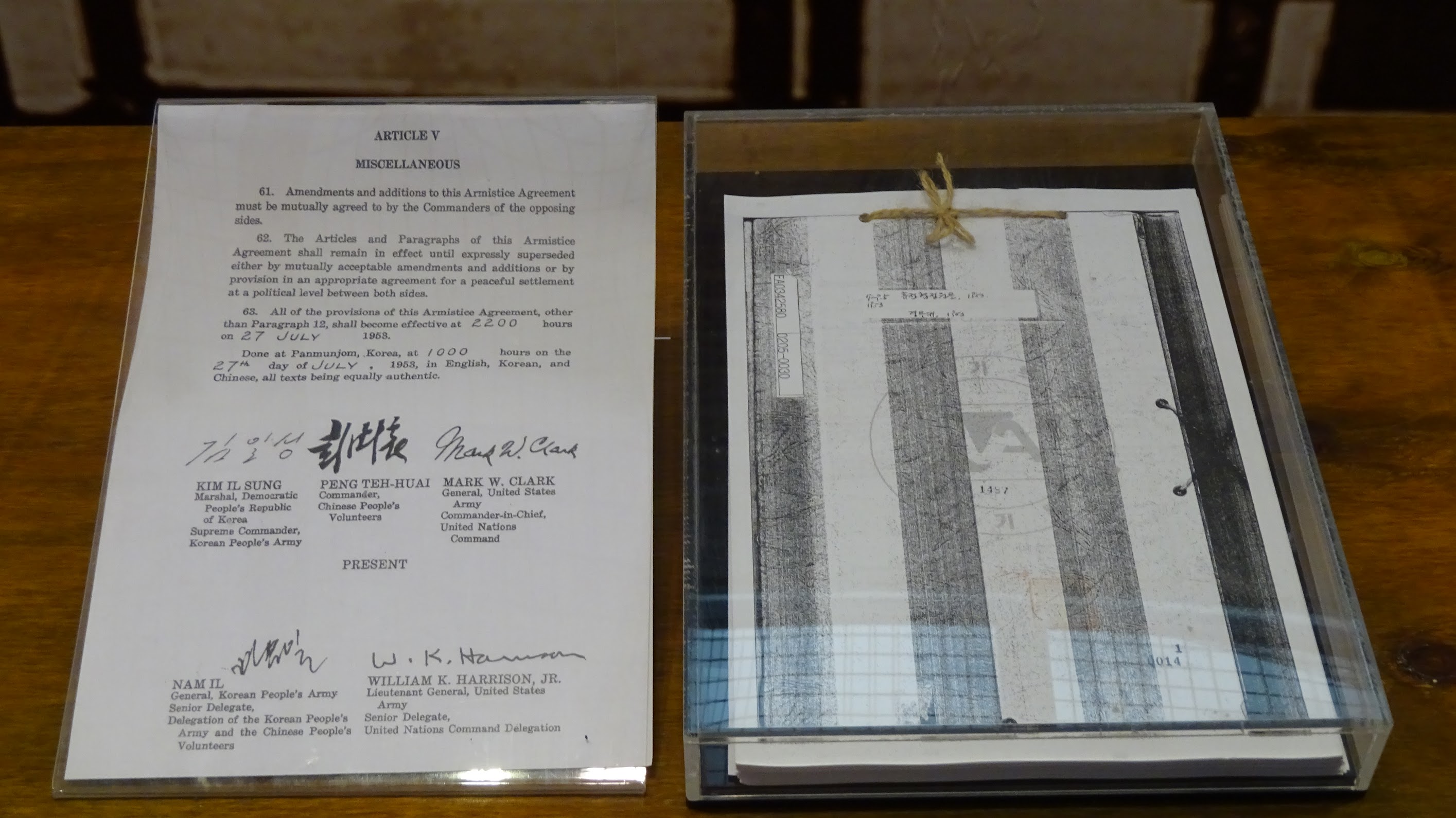
We were taken back and given time to explore the small museum they have. We found out more detail about the armistice and things that happened in and around the DMZ. There was a grizzly exhibit about an axe murder that took place in the 1970s when North Korean guards attacked South Korean ones.
Check out the latest price for the tour on seoulcitytour.net
Final Thoughts
This was not a cheap tour by anyone’s standards but I really feel like it was worth every penny. I learned so much about the conflict, it’s background and aftermath. I was impressed at how much we saw, it was pretty non-stop. Originally I meant to book with another company but seeing their huge coach made me very happy that I had booked the tour with a smaller company. I would recommend taking this trip 100%.

Check out Are You a Dark Tourist? The Best Dark Tourism Places Around the World
Information
Booking – I booked through Viator, and there are various length and prices. Ours was run by Seoul City Tour and was called “DMZ & JSA(Panmunjeom) Tour”.
Cost – Around £100p/p depending on the exchange rate.
What to take –
- Passport – This is vital to enter the DMZ. Without it you won’t get past the reunification bridge.
- Clothes – Respectable clothing is required. Collared tops with no cleavage. Trousers and skirts must cover the knees. No sportswear. No ripped jeans or the like. Shoes must be closed, no sandals. There can’t be any offensive slogans. They really do a clothing check before you enter the JSA.
- Sun cream and water – if it’s sunny.
- Camera – You wouldn’t want to miss out on those all important snaps.
- Pillow -It is a long day and you may want a snooze on the way back, or just to ease the pain of a long coach journey on your back.
- Passport – I’m going to say it again because it is SO important!!
Rosie xx
Love it? Pin it! -

Seoul Food – Eats and Treats in South Korea
When people asked me what I wanted to do on my 4 day trip to South Korea, I replied (every time) “EAT”! For a long time I had heard of Korean specialities, tried finding them here in London, but the chance to eat some proper Seoul food filled me with anticipation. If like me, you can’t wait to try some unusual foods in South Korea, some traditional Korean food or just a few bits of Korean street food, then read on to discover how we got on in the hunt for South Korea’s Seoul food.
(more…) -

121 Floors Up – Seoul Sky, Lotte World Tower
Seoul, the capital of South Korea is home to around 25 million people. That’s half of the population of the entire country. It is also home to our friend Lucy, and in May 2017 we finally visited. One of the few things that we booked ahead of time, was a trip to Seoul’s newest attraction, Seoul Sky.
Seoul Sky
Seoul Sky is housed in the Lotte World Tower, the 5th tallest building on earth, up at the 117th – 120th floors. It is the world’s 3rd highest observation deck and opened to the public on 3rd April 2017. The building goes up just 3 more floors, so you are within touching distance of the very top.

The Morning (or was it still last night?)
It’s a good thing we booked in advance. Our quiet night out had evolved from a couple of drinks to a few, then a couple more, then Long Island Iced Teas, then singing our hearts out in a Noraebang (a Korean karaoke room). We rolled in at 08:00am and consequently, I was a little worse for wear all day.
Read all the great foods we ate in Seoul
Getting There
When we eventually left the house, we caught the subway down to Jamsil station, which took us about an hour.

To reach the Seoul Sky observation deck entrance, you need to pass through the central plaza of the Lotte World Mall which would feel right at home in Dubai. These shops sell luxury brands, and the whole thing is very gold. The mall is just one of the Lotte company’s vast retail portfolio. They know their shopping!

Tickets
In the ticket lobby, you can purchase tickets or exchange mobile tickets for paper ones before you proceed with your journey. There are screens showing the availability of tickets by 30 minute time slots, as well as others with the pricing.


A little guide to what you should be able to see. This will help you decide whether to go up or not. I can see that Seoul Sky will get busy, particularly during Korean or Chinese holidays, or during special events in the city (like the 2018 winter Olympics). When we visited, on a normal Sunday evening, there was barely any queue and I would have been very angry if I had paid for a fast pass.
Here you can see the first of many screens sending glowing patterns skittering across the lobby.

The Pre-Amble
The queuing area has yet more dancing colours. I thought it looked like the coolest screensaver Windows had ever managed, Karl said it was an artwork called “The Birth of Korea“. The queue backs up a little here due to the obligatory green screen photo opportunity.

Passing through airport style security (it’s nice to see super safe South Korea taking security seriously) you descend one floor to a small exhibition hall. This is full of more screens, it’s all very pretty. A tree that changes seasons; red autumn leaves, snow covered bare branches and pink fluttering blossom.

They are clearly expecting long queues, as even the queuing corridor ceiling (for queues over an hour) are screens showing intricate patterns that are changing colour every few seconds.

The Lift
The lift (or elevator if you’re that way inclined) up to 117th floor is double decker. It too has screens on all four walls and the ceiling. As it climbed at ear-popping speeds of up to 10 metres a second, I couldn’t decide whether to watch the floor counter or the animation of Seoul rising from the past green fields to the city it is today. It was all really rather exciting.

The doors opened and we were blinded by the sun flooding through the windows. We always try and go to tall buildings for sunset. It allows you to see the city by day, and by night as well as the sunset itself. The sun was 25 minutes from the horizon and so it streamed in horizontally.

Not a real skyline Floor 117
The view along the Han River was lovely. The light gave everything a golden hue. It was genuinely lovely, but slightly spoiled by the dirt spots on the window. It made all our photos a little smudgy.


These columns are padded just in case you are so busy looking out the window (or at your phone) you bang into them. We took a few photos with our own phones and then spotted the photo zones. Here, you can scan the QR code on your entrance ticket and a camera above you will take a snap. It’s a very high angle so you can see how high up you are.

These can be looked at and purchased at the photo shop on floor 119, along with the green screen shot from earlier.
Floor 118
The next floor up has one of the Seoul Sky’s party pieces, a glass floor that you can traverse. It is a knee-knocking 478 metres above ground level. People groan quietly as they take tentative steps forward. An older Korean lady side stepped her way along the support beam that she could see between the glass sheets. I offered her my hand and she held it all the way back to the perceived safety of the carpet.

There is another photo point here, but it is manned by somebody to make sure you get a good shot. We didn’t end up buying any of our photos, but this one was a close run thing.

Elsewhere on this level you’ll find another area of glass floor. This is completely opaque and you may be wondering what the point is. That is, until a member of staff presses a button and the glass goes clear in a second. You can feel your stomach drop away from you, even if the rest of you stays firmly where it is.

There is a tablet which allows you to have a look around digitally. It can point out tourist attractions and even shows you Seoul of the past for comparison. We had fun spotting helipads and swimming pools, a tradition when up a tall building for the Flying Fluskeys.

Floor 119
Up again and you will find the photo shop. Here you can check your photos on the interactive screens and order the ones that you want. You can get physical prints and digital copies. These are on the pricey side but that is only to be expected. They do have very cute frames though.
There is a small cafe with a few drinks but not much else as the balcony looks over the floor below and this is where you’ll find the first queue for the lift back down.
Read about our trip Entering Korea’s DMZ – A JSA, Imjingak and Third Tunnel Tour.
Floor 120
The last escalator whisks you up to the 120th floor with the outside sky terraces. These half exposed terraces are placed at either side of the building. We were expecting it to be draughty, but the floor to ceiling windows kept the wind at bay. There is a net above you,to stop silly people throwing things over, and naughty birds making their nests. This is all that stands between you, and the sky.

I really enjoyed the sky terrace, but I couldn’t get near the window as there was a very handsome chap who was having the photo-shoot of his life with his girlfriend. The sun had set by now and so the lights reflecting from inside made it hard to get a good photo.


I popped to the toilets on this floor (available on floors 118 – 120) and was treated to a Japanese style WC. If there’s one thing I love in a bathroom, it’s a warm bottom!
There is a souvenir shop selling everything from notebooks, to crystal models of the tower. (These looked slightly naughty from afar, but that’s what happens when you’re selling a six inch replicas of a slightly curved tower).
Floor 121
Up a set of flashily lit stairs there is a small coffee shop. It’s part of the Angel in-us Coffee chain that you find around Seoul, but it has sky high prices(!) to match its location on the top public floor.
Information
Location
Jamsil station is on the Seoul Subway Line 2 (the green line) and Line 8 (the pink line). Find Exit 2 and enter Lotte World Mall.
Prices:
Correct as of May 2017
Adult – 27,000 KRW (£18.50)
Children – 24,000 KRW (£16.50)
Fast Pass – 50,000 KRW (£35)
Times:
Open from 09:30- 23:00 Daily
Website:
https://seoulsky.lotteworld.com/en/main/index.do
Check out all our travels in South Korea
Anything Else?
If you have access needs or have a baby buggy with you, it’s worth noting that there is a separate lift to move between all of the Seoul Sky floors.
The lift on the way back down is very pretty but I won’t ruin that one.
There is cheap, good food and drink in the subway station at Jamsil but you can’t take it up the tower, so wait until you’re done.
Rosie xx

-

Backpacking with Burgers – Munching on McDonald’s
My hubby, Mr Fluskey, has a travel quirk that most people don’t understand. He likes to eat a McDonald’s Big Mac in every new country he visits. After a long debate about this, I bent to his will. To try and alleviate my slight corporation guilt, I try to eat something from the menu that we don’t have at home, like the samurai burger in Thailand. So why does he love munching on Mcdonald’s?

Munching on McDonald’s
We have eaten burgers across the world, ranging from utterly delicious (in India) to truly terrible (the burgers in Indonesia were little better than chewing polystyrene). I really couldn’t work out if I enjoyed my chicken shakers in Japan. But there was a particularly saucy little number in Copenhagen, Denmark that left me in an ecstatic BBQ mess. In South Korea there was lots to great food to eat, (check out Seoul Food – Eats and Treats in South Korea) but we still tried the local golden arches offering!

Shrimp Beef Burger, Seoul, South Korea Only six countries have thwarted Karl in his beefy conquest so far:
India
Big Macs are not served in India, in fact there are no beef burgers whatsoever on the menu in this mostly Hindu country. Instead they serve the Maharaja Mac.

This is built like a Big Mac (two patties, the extra bun in the middle) but consists of two chicken burgers and a mild curry sauce. We enjoyed this burger so much, we went back two weeks later for another one.Check out all of our travels in Incredible India

Vietnam
When we visited Vietnam in 2009, McDonald’s was still forbidden fruit. With many investment restrictions stopping some of our best known big western businesses setting up shop, McDonald’s were kept at the gates. Weirdly there was a KFC in Hanoi and Karl accepted this as a substitute. The restrictions were loosened in 2014 and the countries first McDonald’s served 400,000 customers in the first month. The Vietnamese obviously love munching on McDonald’s as much as Karl does.
Check out all our travels in Vietnam
Transnistria
As an unrecognised Soviet country, there is little to no western investment in this tiny place. We went out for a pizza but I know Karl must have had a burger-y niggle in the back of his mind.
Read all about when we spent One Night in Transnistria
Iceland
McDonald’s served its last meal in Iceland back in 2009. The countries economic problems meant that the franchise became too expensive to run and so they closed their three branches and left Reykjavik’s residents to enjoy homegrown fast food joint Aktu Taktu. We did the same when we visited in 2012.
Read 4 Days in Iceland – A Long Weekend in the Land of Fire and Ice

Jonathan eats chips from a red tray in Aktu Taktu in Iceland Laos
On our travels through South-East Asia in 2009, I got to eat delicious, cheap food through Laos without the glare of the Golden Arches.
Read about all our travels in Laos
Cambodia
I’d like to say that we ate really healthily when McDonald’s was nowhere in sight, but I ate a lot of super noodles for breakfast in Cambodia. It’s traditional, but not much healthier than a burger really.
This habit can be a little bad for our waistlines. When we are dashing through countries Karl needs his fix once every few days (where available). I used to roll my eyes when we entered a McDonald’s abroad, wondering if the other people in there thought we are too scared, or too fussy to try the local food. But I have since come to realise that they are in there too and a sneaky Happy Meal doesn’t hurt once in a while.
And for a bonus point.
Aqaba, Jordan, it’s 46 degrees centigrade, it’s Ramadan and everywhere is shut. In the distance we spy the golden M. It is open, but we can’t have any food, or sit in the air conditioning, or on the veranda. We got the biggest iciest drinks we could walked away with our very hot tails between our legs.
Check out our Your 10 Day Jordan Itinerary – World Wonders and Wadis

Rosie xx