Victoria Falls is a destination awash with nostalgia. From the Victoria Falls Hotel and its Edwardian grandeur and high tea, to the giant statue of Livingstone that overlooks the falls themselves. There is a very post-colonial whiff about the place, and we got a little swept away with it. To recapture a little of that bygone era, we decided to jump aboard the quintessential Victoria Falls steam train experience. Read on for our full and honest Royal Livingstone Express review.
When we began our research into Israeli cuisine, we realised just what a confusing business it is. Israel has influences from its direct neighbours, and much further afield. The best way to get our heads around it was to explore the wonderful array of choices with the experts. Enter Delicious Israel and their Eat Jerusalem tour around the Machane Yehuda market.
Whether you are completely addicted to Chernobyl Diaries and want to check out the real thing, love dark tourism or are just visiting Ukraine, a day trip to Chernobyl should be on your list. We took this once-in-a-lifetime day trip to Chernobyl in 2013 and its strange blend of life and death, light and dark, have stayed with me ever since.
Chernobyl Town Sign
What Happened at Chernobyl Reactor No.4?
In the early hours of 26th April 1986, a safety test was run in reactor no.4 at the Chernobyl Nuclear Power Plant. It had been planned for the day before but was delayed until the next shift was on the site. The test was being conducted to help pinpoint and solve known flaws with the Soviet reactor design. Power outages were common towards the end of Soviet rule and so it was vital they find a way to ensure the reactor remained cool between a loss of mains electric and the generators kicking in.
Chernobyl Power Plant and River
The workers that night were not fully briefed, vital safety systems had been switched off, and the whole test was rushed. They made fatal mistakes that allowed the reactor core to overheat, causing an unstoppable nuclear reaction. Two large explosions blasted the reactor open and subsequently set it ablaze, a fire that lasted 9 days. Radioactive smoke and fallout pumped into the atmosphere and the USSR decided to keep it quiet. More on that later…
What Happened After the Chernobyl Disaster?
The first that the rest of Europe knew of the danger carried on the wind was when Sweden reported it two days later. Forsmark, a Swedish nuclear plant alerted the government about unusually high levels of nuclear isotopes they wouldn’t normally detect. Sweden contacted the USSR, who continued to deny the accident.
A normal background radiation worldwide is about 2.4 millisieverts
The rain that fell across Sweden was contaminated and the radiation affected the food supply chain that summer. Reindeer were particularly affected (no, that isn’t how Rudolph got his weird red nose). Lichen is very good at absorbing radioactivity and it is this lichen that reindeer LOVE to eat. That year 80% of the reindeer meat bound for sale was destroyed as it was highly radioactive and too dangerous to eat. Eventually, the Soviets admitted what had happened and an exclusion zone was set up. Access to a 30km zone around the disaster area was restricted, and a smaller zone (10km) even more so.
With all that…
…Why Would You Want a Day Trip to Chernobyl!?
When I told my mother that Mr Fluskey and I were intending to take a Chernobyl day tour, her reaction wasn’t positive. Somewhere between disapproval, shock and puzzlement; there is no emoji that would cover it. Memories of the late 1980s and the fear the disaster created still ripples across her features. She was very newly pregnant with yours truly when it happened.
However, I am an insatiable dark tourist. If something seems a tiny bit dangerous, dark or morbid, I am awfully tempted to see it for myself.
Absolutely! Not only can you tour Chernobyl, but we think you should tour Chernobyl! It is a fascinating day tour unlike any we have taken elsewhere. This is not a self-guided excursion, you must sign up with a tour company. They will ensure you have a safe and enjoyable day, as well as giving you a thorough education about the Chernobyl disaster (if you needed more than that tiny introduction at the beginning of this post).
“Hang on, you said safe”…
…Is Chernobyl Safe to Visit?
We were worried about the amount of radiation we would be exposing ourselves to but the guide told us a fact that both amazed and horrified us.
“You will be getting as much radiation today as you would flying between London and New York”.
Now, we fly rather a lot so I am now wondering just how much radiation I have coursing through my veins…but I digress. There are areas of higher radioactivity and you won’t be allowed to spend that much time there.
There is obviously some radiation; the tour guides can only work in the area for half of the week. They do tours for 3 or 4 days and then take the rest of the week off. The people who work and live in the research facility in Chernobyl Town spend 15 days on location and then 15 days living elsewhere.
Wait a Second…
People Live In Chernobyl?
That’s right, people actually live in Chernobyl. There are the researchers as mentioned above, they reside in Chernobyl Town inside the 10km exclusion zone. However, their time there is limited and monitored.
There is another group of residents who don’t limit their time in the area. After the disaster, a small but determined group of senior citizens decided to return to their homes (in fact, some never left when the area was cleared). These Samosely (self-settlers) grow crops here and lead solitary but happy lives in this supposedly hostile territory.
Ready to visit Chernobyl for yourself?
What is The Best Tour Company to visit Chernobyl With?
We wholeheartedly recommend SoloEast for your day trip to Chernobyl. We did lots of research before choosing them and we had a great experience with them. They have been running tours to the exclusion zone since 1999 so they have plenty of experience.
Our Day Trip to Chernobyl with SoloEast
Getting to Chernobyl
We met the group in Independence Square (Maiden).
Independance Square, Kiev
The representative checked our passports and gave us a wristband each. These weren’t to indicate our all-inclusive drinks package, or to help us if we got lost. I think they were just so we could get excited about the day ahead. Together we boarded the bus and began our two-hour journey to the exclusion zone.
To pass the time, and get everyone clued up, the bus TVs showed a documentary all about the Chernobyl disaster. It was a very dramatic documentary with lots of re-enactments and loud, urgent classical music. It was just right!
Check out the tan I had leftover from our trip to Jordan!
The chaps behind us were in town for the England vs Ukraine match that had filled up Kiev with football louts. They chatted loudly, sang football chants and generally made a racket. We struggled to hear the video over them but there were subtitles so at least we could read along.
On entering the exclusion zone, we stopped at a checkpoint and had our passports checked. Without your passport, you aren’t going to get in so don’t forget yours!
Welcome to Chernobyl Town
Just before leaving Kiev, we had been given our assigned Terra-P dosimeter-radiometers.
These measure radiation in the surrounding area and communicate the result through a numerical reading and by the frequency of a clicking noise. As we waited to disembark our bus, dosimeters were clutched eagerly in anticipation. On the ground, they started to click enthusiastically and the tour group grinned at each other with knowing dark tourism glints in their eyes.
I think most of the group were expecting a run down and ragged settlement in Chernobyl Town. We were slightly surprised to see a well kept and neat little community.
Wall murals in ChernobylWall mural in ChernobylEven the staff transport seems stuck in time here
However, this is a small section of town and if you wander off the beaten path, you are very quickly in a wilder environment. We ventured down the road slowly, stopping to take photos of the houses; looted many years ago, and overgrown they were in a state of disrepair. After a few minutes, we heard a distant animal howl, followed swiftly by another. Perhaps a dog or a wolf, it was time to retreat back to civilisation.
One amazing aspect of the exclusion zone is the way Mother Nature has staked her claim. Of course, the radiation had a devastating impact on some areas but in others, the effects were short-lived and the following years without human interference gave nature a chance to bounce back. Packs of wolves roam the woods, reclaiming old hunting grounds, small mammal numbers are back to normal and plants flourish in and around the structures crumbling in old villages. There are contradicting studies highlighting issues for certain species related to radiation but overall the picture seems to be unexpectedly good.
Visiting Reactor No.4 – Ground Zero for the Chernobyl Disaster
It began to rain a little en route to our second stop and so we jumped down from the bus with heads bowed. Looking up we saw reactor No.4, vast and dark beneath the concrete sarcophagus that was built to secure it and stop radiation from escaping.
Reactor No. 4
There was a small memorial here and our guide advised us to stay behind it as the wind was blowing over from the reactor. We were all a little sceptical but when the wind gusted, the dosimeter-radiometers clicked faster. The concrete sarcophagus had been deteriorating and failing for years and so new plans were underway.
The readings were pretty normal until the wind blew towards usMemorial to those who lost their lives. The inscription reads, “To heroes, professionals to those who protected the world from nuclear disaster. In honour of the 20th anniversary of shelter object construction. 30.11.2006”.
To our right, a huge, HUGE structure was being constructed. The New Safe Confinement (new shelter) is ~150m tall and is designed to fit both the reactor and sarcophagus inside it. This will allow them to be deconstructed safely. The structure was lying to the west when we visited but was moved into position in 2016, it took almost two weeks…I told you it was big! It was tested in April 2019 and it seems to be effective but I don’t think it is in full use as of this post.
The New Safe Confinement
The Workers of Chernobyl
After gazing in wonder at the reactor and the seemingly endless stream of workers passing through a staff entrance, we were ushered back to the bus.
I was wondering how the workers spent time in such close proximity to the epicentre of the accident. It turns out they have a strict roster and are only allowed a certain dosage of radiation per month and year. According to Wikipedia, spending just 12 minutes up above the roof where the concrete sarcophagus leaks, will result in a full year’s allowance!
Maybe that is why look a little unnerved
Kopachi Kindergarten – The Photo Op
It is easy to get swept up in the myths behind the Chernobyl disaster when you are on a day trip to Chernobyl. The devastation of anything to do with children is very affecting, but I couldn’t help but suspect a little window dressing here. Inside the kindergarten building, papers were strewn across the rooms and the bunk beds stood bare. I guess this was also looted years ago.
The noticeboardRuined roomAbandoned toysThe bunk beds of the absent children
However, outside lies a doll, missing some of her tiny plastic limbs. I wonder when it appeared here for the tourist’s delight…maybe that is too cynical and it was abandoned by a three-year-old when she was evacuated. Either way, I snapped it with gusto and hovered the dosimeter over the area squealing with delight as the numbers rose. As I boarded the bus, I imagined whacking a vintage, black and white filter over the pictures to increase the dramatic gravitas of the photos.
Liquidator Statue – A Fitting Memorial
The spot that I found genuinely moving was the memorial to the first responders. It shows the firemen who tackled the blaze. These brave men rushed into the fire without a clear sense of just what they were facing. On the other side, plant workers are depicted. This structure documents them beautifully. I think it’s a shame that it is stuck within the exclusion zone and is therefore unseen by the wider world.
Lunch in Chernobyl
We were treated to traditional Ukrainian dishes. The tastes of potato and beetroot were prominent. All of the food was brought from outside the exclusion zone, they were very keen to stress this! It wasn’t the best food ever but it was filing and included in the price so no complaints here!
Looking for other unique, amazing experiences around the world? Check out our bucket-list travels
Visiting Pripyat – The Town Where Time Stands Still
This was undoubtedly my favourite part of our day trip to Chernobyl. It was sad, interesting, creepy and cool all at once.
Pripyat City Sign
Pripyat was the closest city to the Chernobyl Nuclear Power Plant and was built to serve it. Most of the residents worked at the plant and enjoyed a lovely Soviet life. Pripyat was a model town with great communal facilities like the Palace of Culture, Azure Swimming Complex and Avanhard Stadium. We were not allowed to enter the buildings as they were too dangerous by 2013.
Abandoned workers homesApartment buildingPolissya HotelComparing old photos to the modern situationThe Palace of Culture EnergetikSoviet art
In fact, the town was preparing for the official opening of a new fun fair on 1st May. 1st May was a special day in the calendar of the USSR, marking Labour Day or workers day. Preparations were underway for a big parade and the posters are still visible. The vintage Soviet paintings were just as you’d imagine.
Paintings of Soviet leaders left in PripyatSoviet art in ChernobylSoviet art in Pripyat
The Ruins of Pripyat – The Fair of Nightmares
Entering Pripyat on foot, we meandered through the old concrete buildings; monoliths to the Soviet ideals ravaged by time and conquered by vegetation. The ghost town had a calming effect on the group, even the football lads were quiet as we stepped carefully through the rubble. We picked our way around to the funfair, bumper cars rusting and abandoned, the creaking Ferris wheel looming over us. On the grey September afternoon, it was very atmospheric and satisfyingly creepy. We rather ruined it by running around like small children with our dosimeters, waving them over patches of moss that were giving out large readings.
The Ferris wheel in PripyatAbandoned bumper carsThe Ferris wheel in PripyatChildrens ride in PripyatA high reading at the amusement parkMore ferris wheelThe Ferris wheel in Pripyat
We learnt that the population of Pripyat (roughly 49,000) weren’t evacuated immediately. Families still swam in the pools, played outside and looked forward to their go on the new rides popping up around the corner. Instead, buses only arrived to move them 36 hours later on 27th April. Most of them didn’t even know they were to be moved permanently so they didn’t pack their belongings properly, assuming they would be back in a day or two. They were never permitted to return.
The Red Forest
The area that was most affected by the Chernobyl disaster was a pine forest that was all but killed off. The pine needles turned a dirty rust colour and small mammals and insects were wiped out. We stood on a road bridge here, staring at the forest, still unrecovered. The dosimeter counters clicked furiously as the wind blew through the trees, in our direction. We were quickly directed back to the bus.
Getting Back to Kiev from Chernobyl
We sped through a desolate area apparently high in radiation. The guide asked if we wanted to open the windows and test the air. In the morning, this would have freaked the busload of tourists out, but at this late stage of the day, we were all keen to see just how high the counters would go. Someone stuck their dosimeter counter out of the window and it read 25. That was considerably higher than anything else we had seen…we closed the window rather swiftly.
As we left the exclusion zone, we once again passed through the checkpoint. We were asked to leave the bus and exit through the building. Inside there was a line of strange metal machines. They check the levels of radiation on a person. The group had to step into the contraptions one by one and wait for the green light. The metal gates would then open and the person could exit. What would have happened if the light had gone red? Who knows! All I know is that, although we all laughed at the explanation, everyone left with a real sense of relief at the green light!
What to Pack for a Day Trip to Chernobyl
Your passport – You MUST have your passport with you to go on this day tour!
A hat – No, they don’t suit me either, but if SoloEast recommends it, I am putting one on! It doesn’t have anything fancy, just something to cover your head.
A water bottle that has a lid – You will get lunch but drinks aren’t forthcoming. Why the lid? Well, you know, better to be safe than sorry right?
Shoes that cover your feet – They should enclose your feet completely, be sturdy and comfortable.
Clothes that cover your skin – I think you are getting the idea here. Basically, the less you expose, the better.
A good camera – You will be showing these pictures off for a long time to come.
Sun cream and an umbrella – Because you just never know!
Information for Your Day Trip to Chenobyl
SoloEast runs tours daily from Kiev, the capital of Ukraine. This is the best place to base yourself for these tours.
A day trip to Chernobyl will last around 10 hours and includes lunch and insurance.
A one day tour will set you back around £72/$100.
You can pay an extra $10 for the Terra-P dosimeter-radiometer counter. This isn’t necessary but it is kind of cool to wander around with your yellow clicker. Others in your tour group will have rented them so don’t worry if you are on a tight budget, you can just piggyback on their dosimeter fun.
SoloEast also runs two-day tours. With these, you stay overnight in the exclusion zone and get a more in-depth tour of the area.
I guess this day trip isn’t for everyone, but if you have made it this far then you must be interested. In that case, you really need to get yourself booked onto a day trip to Chernobyl. Go and book your flights to Ukraine and have a great time! You will be left in awe of the majesty of human ingenuity, and stupidity.
Surely, it is every little kids dream to get behind the bars at London Zoo and help out as a zookeeper for a day? From feeding the monkeys to stroking snakes, it is probably on the bucket list for a lot of grown ups too! It has definitely been on ours ever since we heard that we could be a Zookeeper for a day at ZSL London Zoo.
If you have seen my blog post about walking the Regent’s Canal, you will know that I am a huge fan of this stretch of canal. I will, of course, jump at the chance to hit this stretch of water in any way I can and so I was thrilled to find out about GoBoat London and try one of their boats out for myself.
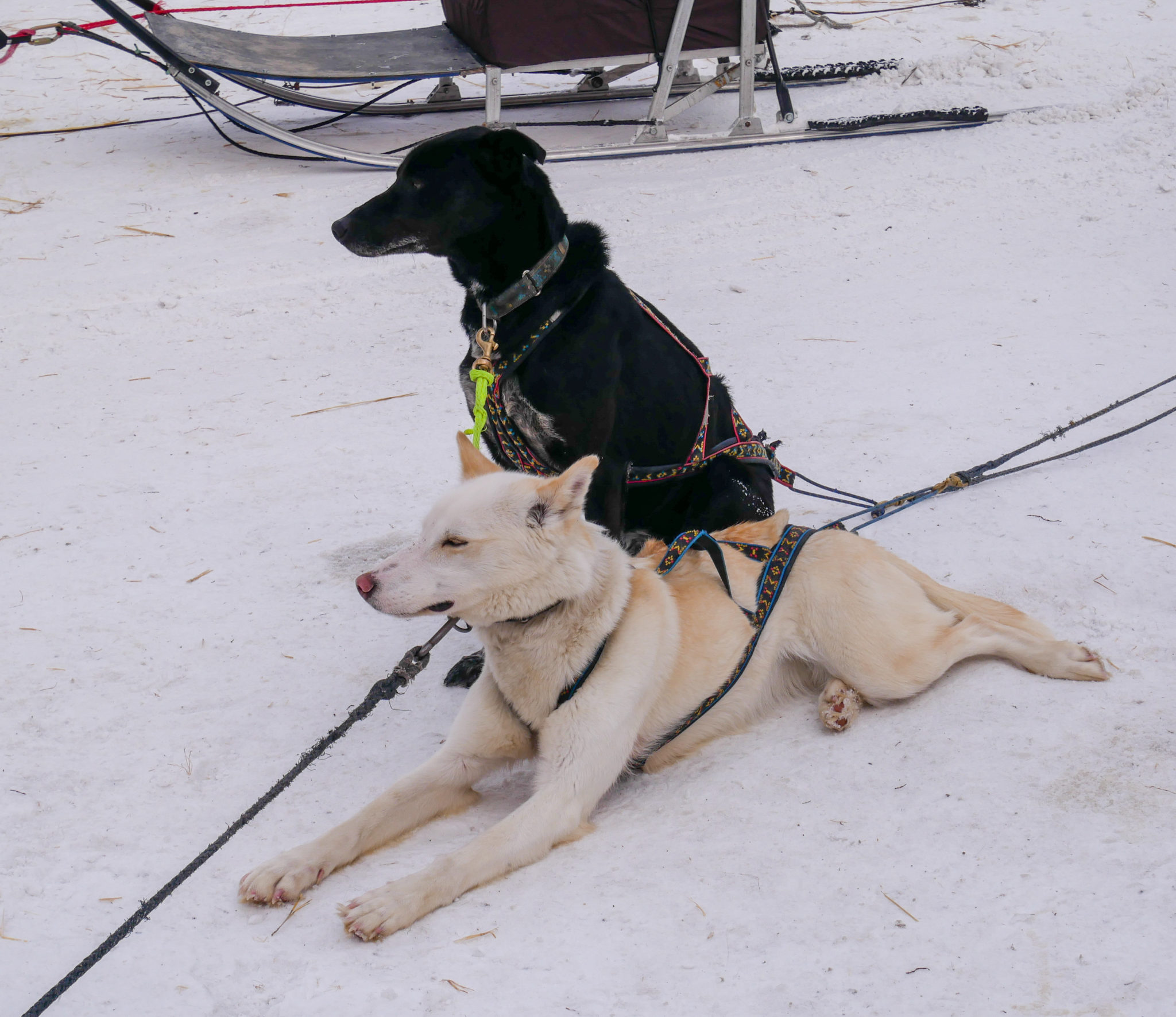
When you think of winter activities there are few that immediately spring to mind. I bet dog sledding is one of them! That is why it has always been on our bucket list and so dog sledding in Russia was must do for our Trans-Siberbian travels. After a little research we found out that the best place to try dogsledding in Russia was a small village called Listvyanka and we signed ourselves up to try Lake Baikal dog sledding.
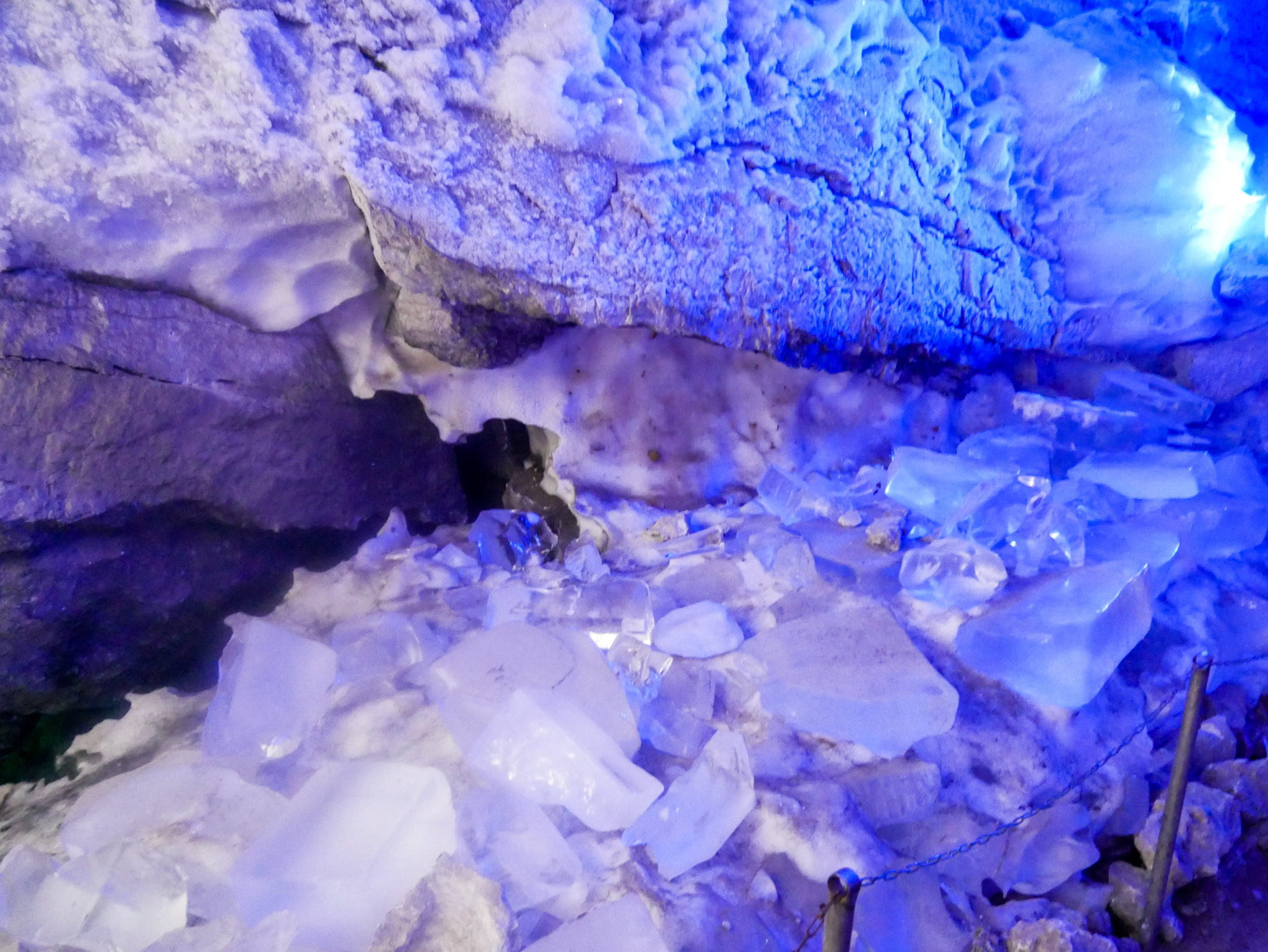
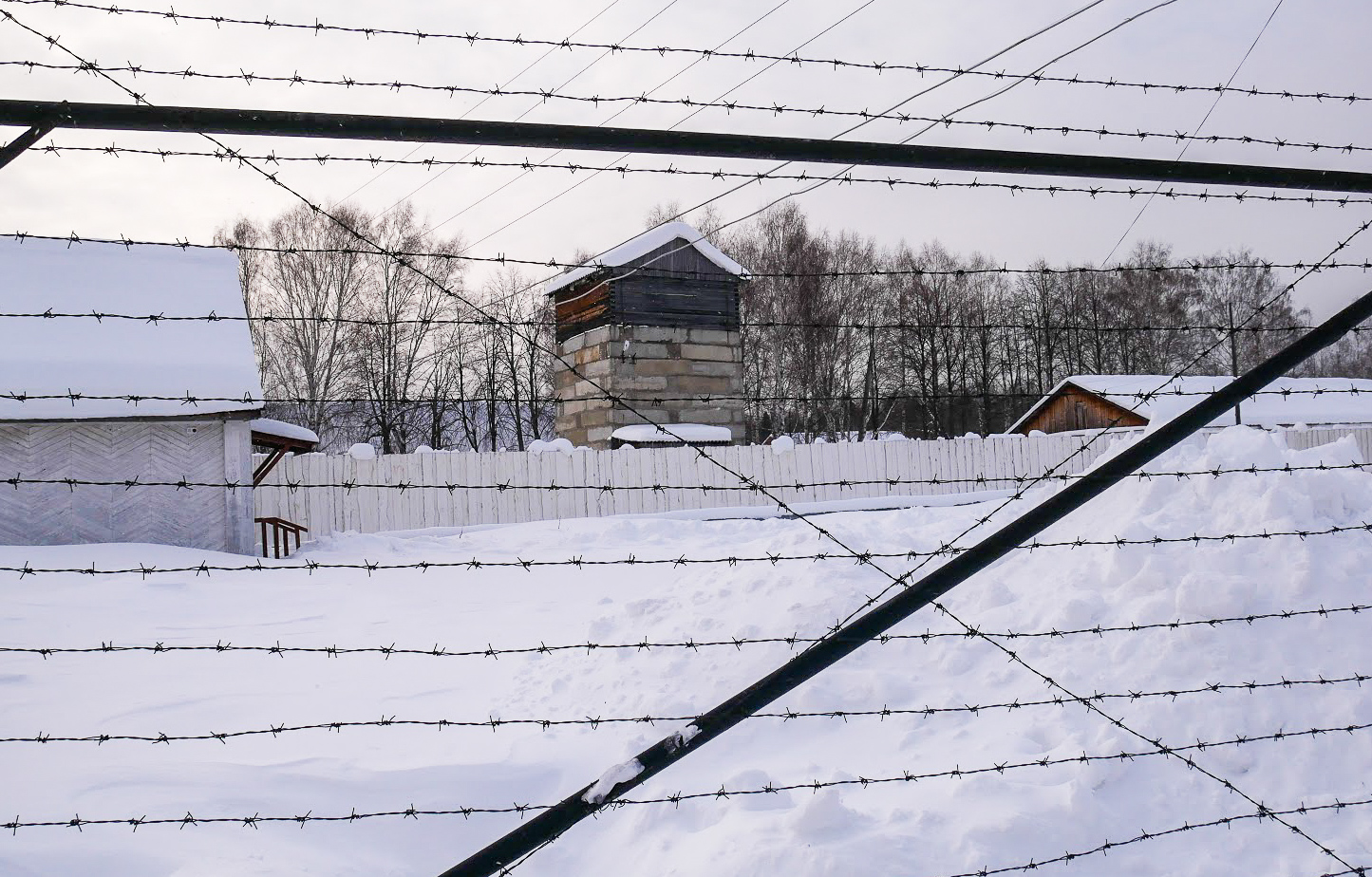
During our visit to Perm, Russia a small city that is a day’s train ride from Moscow, we enlisted the help of a tour company Evrasia Travel Bureau. They set up a day tour from Perm to GULAG Perm 36 and Kungur Ice Cave.
Hopping on and off the Trans-Siberian is one of the coolest ways to explore the vast country of Russia. To see as much as possible, it is worth planning ahead booking the odd day tour. During our winter trip in 2019, we decided to arrange a day trip from Perm tour with Evrasia Travel Bureau to visit Gulag 36 and Kungur Ice Cave. It was the best day trip from Perm we could have hoped for. In this post we focus on the first half of that tour, Perm 36 GULAG
Come to Tofo Beach, and you will hear two phrases that are intrinsically linked; “Megafauna” and “Ocean Safari”. It was these two things that brought us to Mozambique. We were determined to make 2018 the year we went swimming with whale sharks in Mozambique.
What is Megafauna?
Megafauna means big animals, and in Tofo Beach that means:
Manta Rays
Dolphins
Turtles
Humpback Whales
Sharks
And the thing that brought us here, Whale Sharks
A few operators around town offer the chance to join them on an ocean safari to spot, and hopefully meet these amazing animals. We were drawn to Liquid Dive Adventures for both their safaris, and their trendy accommodation.
On arrival at Liquid Dive Adventures, we were given an explanation of how the trip would run. They took us through safety points for both us, and the animals. In the right season, humpback whales enter the bay. If you meet these guys, you are not allowed to get into the water, but with everyone else, you can slide in carefully.
We were kitted out with a snorkel and mask, and a shorty wet suit. It was a very hot day, and it seemed slightly mad to be wearing black neoprene, but once we were wet and zipping across the surface of the sea, the wind cooled us quickly.
The Boat
In Tofo Beach, all the operators use rigid inflatable boats (RIBs). These are structured speed boats with inflatable sides. They all live on the beach until they are launched…..by tractor. That was something I wasn’t expecting; a farm vehicle chugging its way into the sea foam.
The Launch Plan
The whole group helps push the boat, bow first, into the waves. When it’s afloat, the captain shouts “Group one”, and the ladies (or shorter members of the group) scramble aboard. There is no delicate way to do this, you just flop over the sides. The rest of the group pushes it onward, and when they are chest deep, the captain will shout at them to clamber aboard. It’s then up to the captain to chart the boat through the breakers.
On Board
We sat on either side of the boat, slotted our feet into loops on the boat’s floor, and held onto ropes that ran along the side. On the first outing, the sea was pretty still so we didn’t have to hang on, but on our second go out, the waves were a little rougher. We hung on for the whole trip. On board with us, we had a spotter, a guide and the captain. They made sure we were alright throughout the entire trip.
Mr Fluskey and I have a very special skill. We can locate the area on a boat that will get the most wet, and plonk ourselves there, like…well…plonkers! We are often dripping and wet through, whilst those around us have experienced a mild sprinkling at worst. Well we took that skill and made the most of it on our second trip out. The spray from the waves kept us permanently soaking, with sea water in our eyes and mouths. Mind you, it was TOTALLY worth it…read on to find out why.
Spotting Sealife
Bottlenose Buddies
On our first trip out, we were lucky enough to encounter a small pod of bottlenose dolphins. Everyone grabbed their snorkels and hastily shoved them over their heads. We slipped into the water with a minimum of splash, as instructed, and swam frantically under the water to locate them. It was an amazing moment when they zoomed out of the hazy water.
The dolphins looked so relaxed, but their tails must be incredibly strong as they totally outpaced us, even the baby!
Did you know?
When a dolphin has a baby (a pup, or calf), the whole pod looks after it
We got to meet these guys three times before they finally zoomed off into the blue. It was amazing!
Take Two
Our second trip out didn’t go so well. The boat was buffeted by strong winds and waves. The boat had left the relative calm of the bay and gone around the headland into the unprotected coastal waters. We had to go against the swell, which meant that Mr Fluskey and I were wet and cold (because, of our special skill). A couple of boats passed us, going in the opposite direction with the news of a whale shark sighting. We would never have caught up, and so despite the captains and spotter’s best efforts, we gave up.
“We could go for a snorkel in an area with lots of gorgeous colourful fish”, said the guide. There was a general murmur of ascent. This was our last shot at seeing a whale shark, and it was the same for the girl next to us. “This is what makes nature so interesting, you jut never know what’s going to happen”, we muttered begrudgingly.
Whale Shark Win 1
Our boat was riding the waves back towards the bay when our guide jumped up excitedly. “Get in the water! Whale shark”, he cried. We all blinked at him, confused a little bedraggled. It took a few seconds to realise what he had said, but when it had sunk in, we all made a dive for our abandoned snorkelling masks. Into the water we slid, pulses racing and adrenaline pumping. Again, we spun around, searching the ocean for the signature spotted back of the whale shark.
Our first encounterBeautiful markings
On our first encounter, I looked entirely the wrong way and it swum past me. I spent the next few minutes desperately trying to keep up with the group, and mostly getting a face full of bubbles. Everyone was kicking so furiously to keep up with the huge shark, that their flippers left huge trails of white foam in their wake.
Whale Shark Win 2
When everyone ran out of puff, we were hauled back on board, elated and exhausted. Our guide, smiling wryly, asked if we wanted to go again! The second encounter was over almost as soon as it began. As we climbed into the sea, the whale shark sped off. We caught the barest glance of it before it was swallowed up by the sea.
Did You Know?
Whale sharks are the biggest fish in the sea. They are not whales at all…but they are sharks.
Whale Shark Win 3
Once more we flopped onto the boat. The guide said we could have one more go so again we donned our masks and into the water we dove.
This time, I clocked the magnificent beast almost straight away and managed to get slightly ahead of it. I began to pump my legs as hard as I could and turned the Go Pro on. Here is the footage we managed to get. It is a little shaky but it makes me so happy every time I look at it!
I still can’t get over how he looks so calm, like he is hardly moving, but I know that a swipe of that tail would knock you for six. Just listen to me huffing and puffing, it sort of ruins the zen-like atmosphere.
Did You Know?
Whale sharks use their whole body to swim, not just their tails.
We were told afterwards, that our shark was just a juvenile. They tend to be just 6-8 metres long when they hang out around Mozambique, and it’s almost exclusively juvenile males. I mean, I thought he was pretty huge so it was good enough for me!
Did You Know?
Whale sharks can grow more than 12m long.
Back To Dry Land
The way to get the boat back on to the beach is rather thrilling! Everyone is told to hang on, and the captain guns the engine. You are hurtled towards the beach, riding the waves like a surfer, until it all comes to an abrupt halt. To be honest, when they were telling us about “re-entry”, it made me rather nervous, but it was nowhere near as bad as I imagined. Out you all jump, and then the RIB is dragged up the sand by that trusty tractor.
Why Was I SO Obsessed by Swimming with Whale Sharks in Mozambique?
Donsol
So 2018 started out as the year we were going to go swimming with whale sharks in The Philippines. We had made plans to visit an area called Donsol. There is a famous area called Oslob, on the Southern tip of Cebu, but there have been reports of feeding the whale sharks, and the boats injuring the creatures. Donsol is a much more ethical operation. However, the volcano at the nearby Legazpi airport kept coughing up ash and smoke, so the flights were too dubious.
2018 then became the year we were going to go swimming with whale sharks in The Maldives. We were all set to swim with manta rays and whale sharks in an area chock-full of plankton…but we got there a month early. The internet had got it wrong and we really couldn’t afford to hang out in The Maldives for a month soooo……..
That is how 2018 became the year I went slightly bananas and determined that we would get to Mozambique for three days and make it happen! We WOULD go swimming with whale sharks in Mozambique!! (That is why we went out twice).
Information
If you are thinking of swimming with whale sharks in Mozambique, here is some information you might like to know.
After swimming with whale sharks in Mozambique, we were all absolutely buzzing, with grins a mile wide. Sure, it was up to nature whether or not we saw a whale shark. Sure, it wasn’t the ONLY reason we had visited Mozambique, but it was really wasn’t it!
I couldn’t be more thrilled that we got to go swimming with a whale shark, eventually. It also meant a wonderful trip to an under-rated destination. I wholeheartedly think that if you are heading south of the equator, you should take a detour and explore Mozambique; the jungle, the food, the beach and most importantly of all, the sea.
Our time with Liquid Dive Adventures was sponsored but all opinions are our own, and it really was top notch!
SOWETO is Johannesburg’s most infamous suburb. it was once a township out on its own. Its name is abbreviated from South Western Townships. During apartheid, it was a place to keep the black community away from central Johannesburg. However, once apartheid ended, urban sprawl invaded the borders between the Joburg and Soweto. There was a change in reputation and now living in Soweto is a rather trendy thing to do. So why should you visit? Here are 5 reasons to visit Soweto on a township tour during your next trip to Johannesburg.
The waters of the Atlantic are a treasure trove of amazing sea life. On our visit to the Portuguese island of Madeira, we decided to take a trip out on the ocean with VMT Madeira to see what we could find.
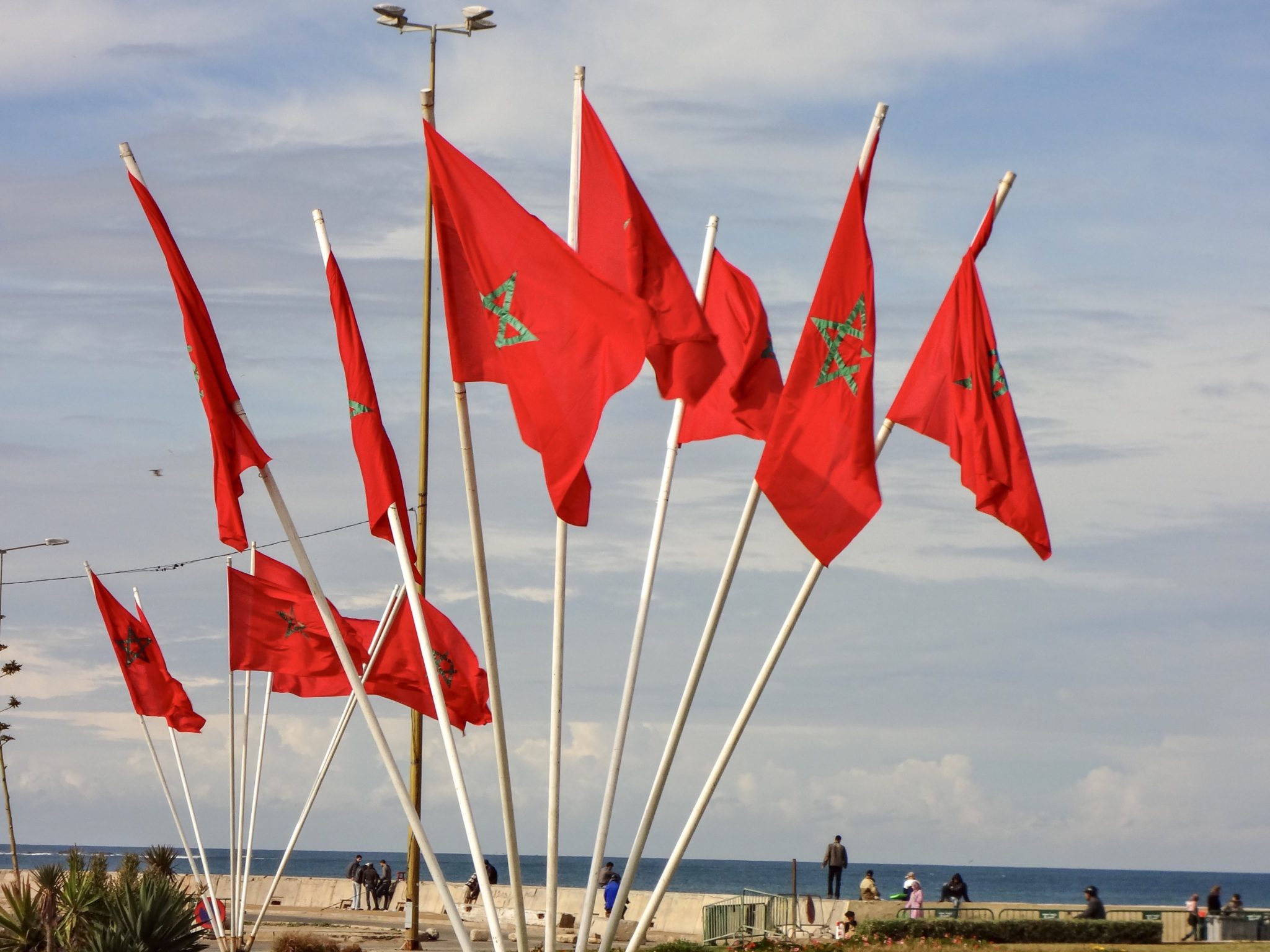
Morocco is the most fascinating country. Sitting at the mouth of Mediterranean Sea, just 9 miles from Spain and Western Europe, Morocco feels a world away. Most tourists head straight for the bustle of Marrakesh to soak up the spice or the beaches of Essaouira to soak up the sun. We chose the first option and decided to do five days, out of season, in the fourth largest city in Morocco. After three days in Marrakesh we decided to take a trip out of the city. We didn’t have chance to venture into the Atlas Mountains, (check out when we did with Gorgeous Morocco on our next trip) and so we spent a day visiting nearby Casablanca (the largest city) and the Hassan II mosque. We discovered what makes Casablanca the perfect day trip from Marrakesh.
Getting There
The Taxi
Staying on the edge of Marrakesh’s medina had its advantages. Sure, we had to walk further to reach the famous main square, but it made it really easy to grab a taxi. Taxi’s in Marrakesh are cheap if you know what you are doing. We let a couple of guys go past who were obviously just out to rip off tourists, but found a good guy who put the meter on without us having to ask, and we were off.
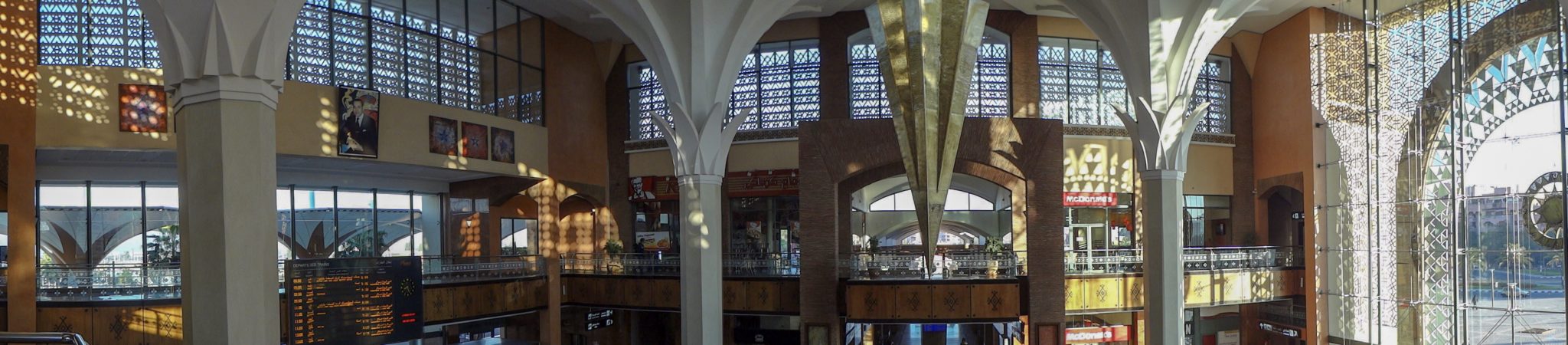
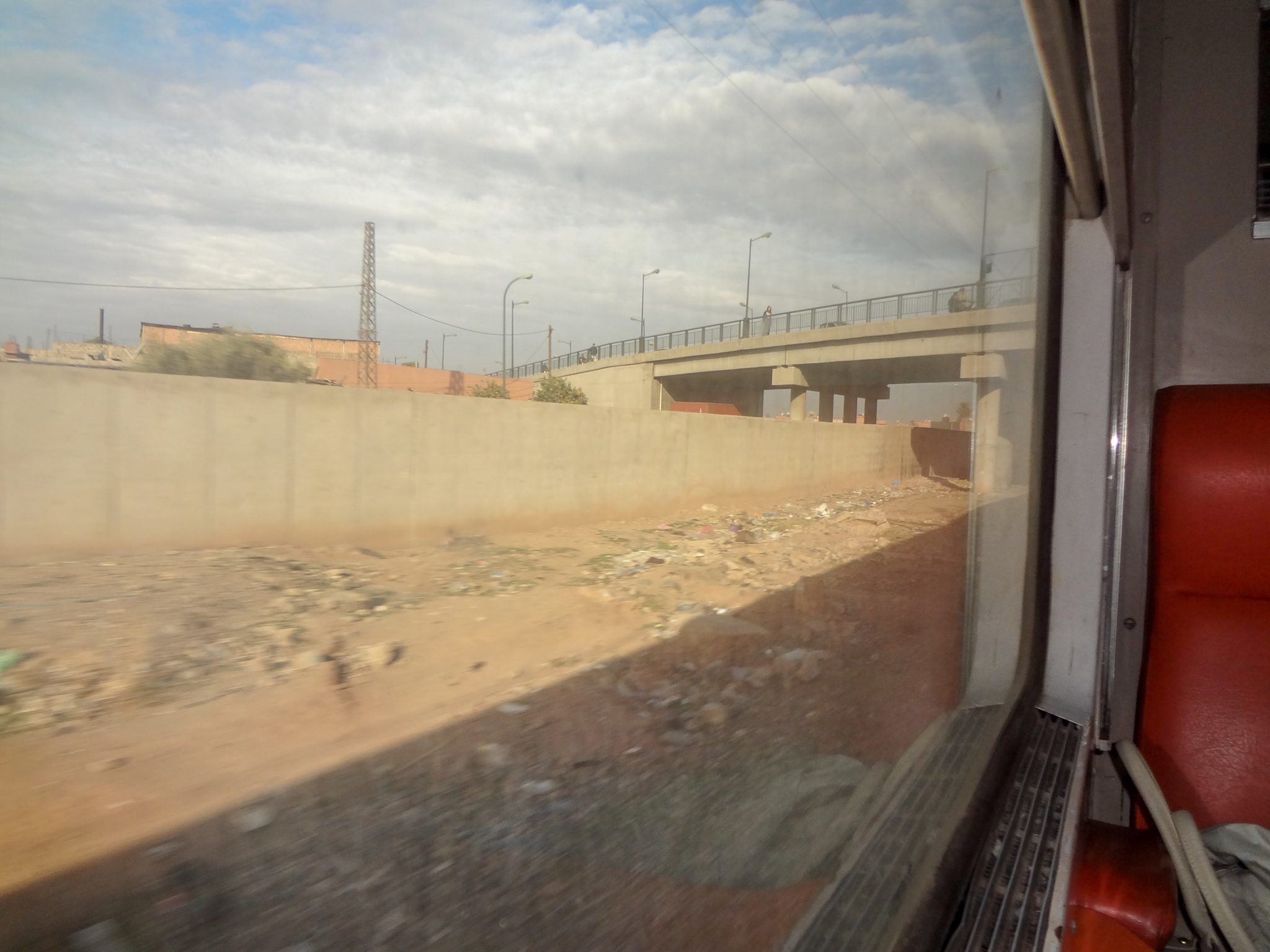
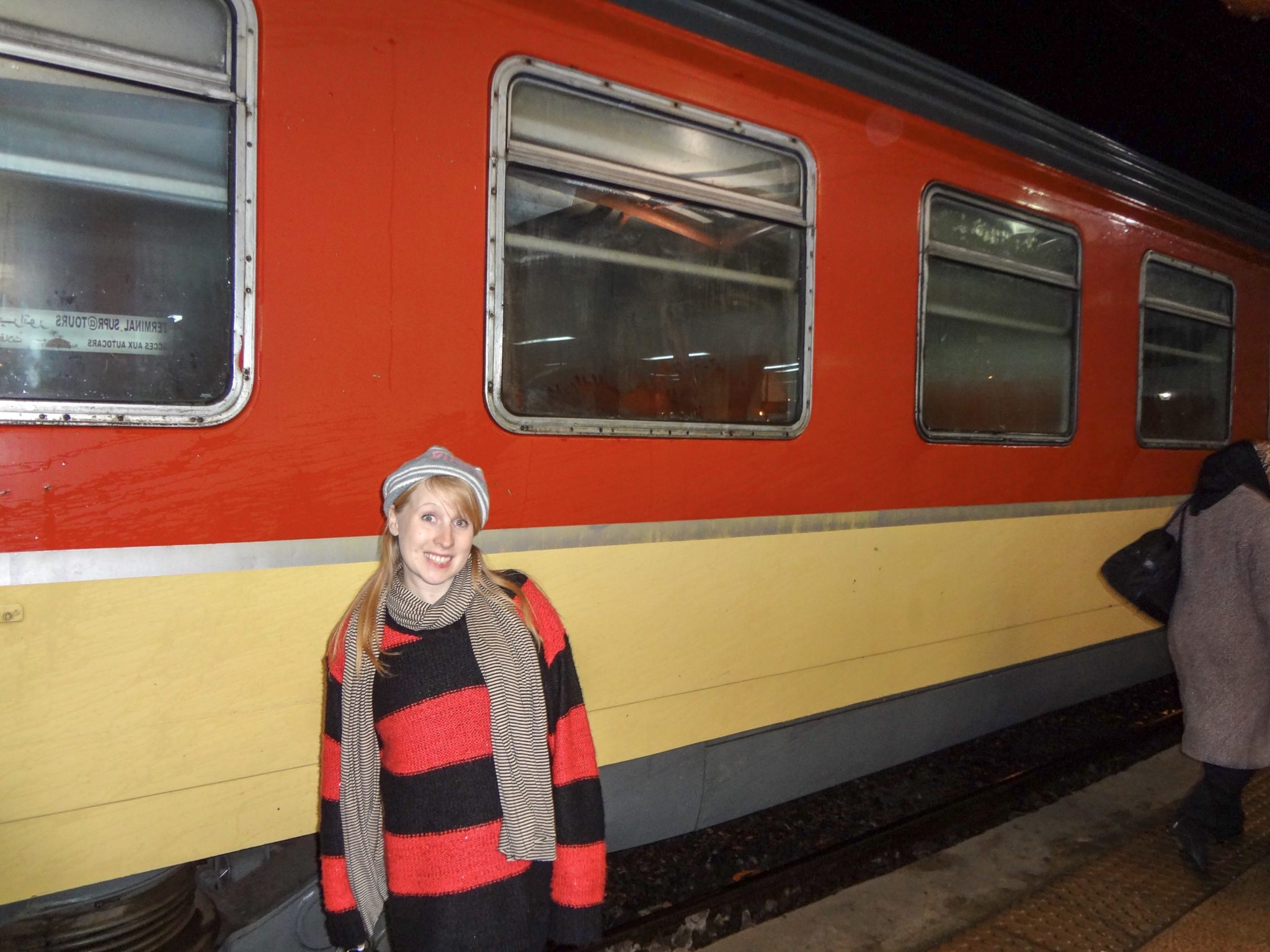
We arrived at the station in plenty of time to buy a return ticket. Our poor school-learnt French really came in useful in Morocco. We grabbed a bit of breakfast from a small concessions stand, to munch on the train.
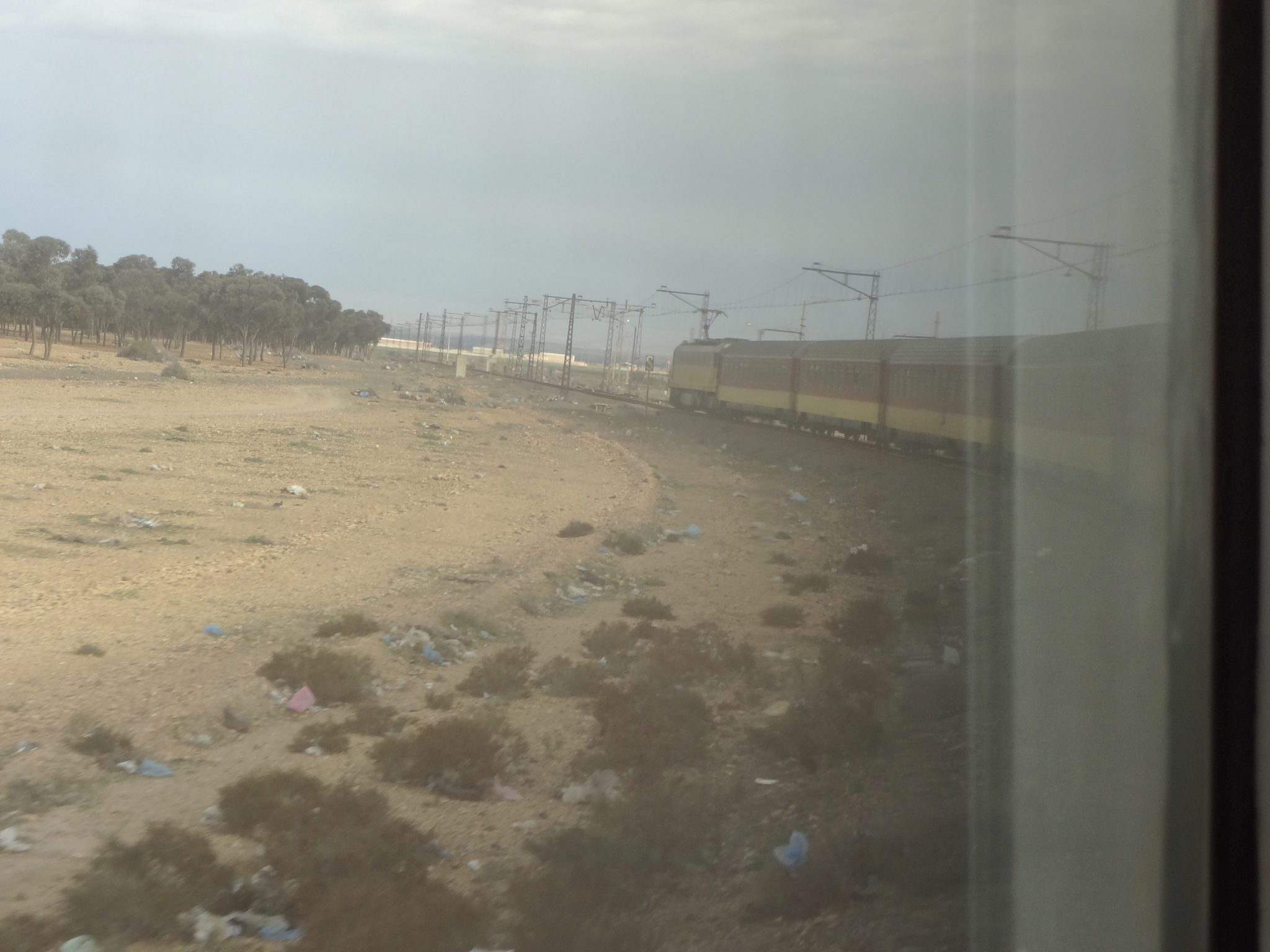
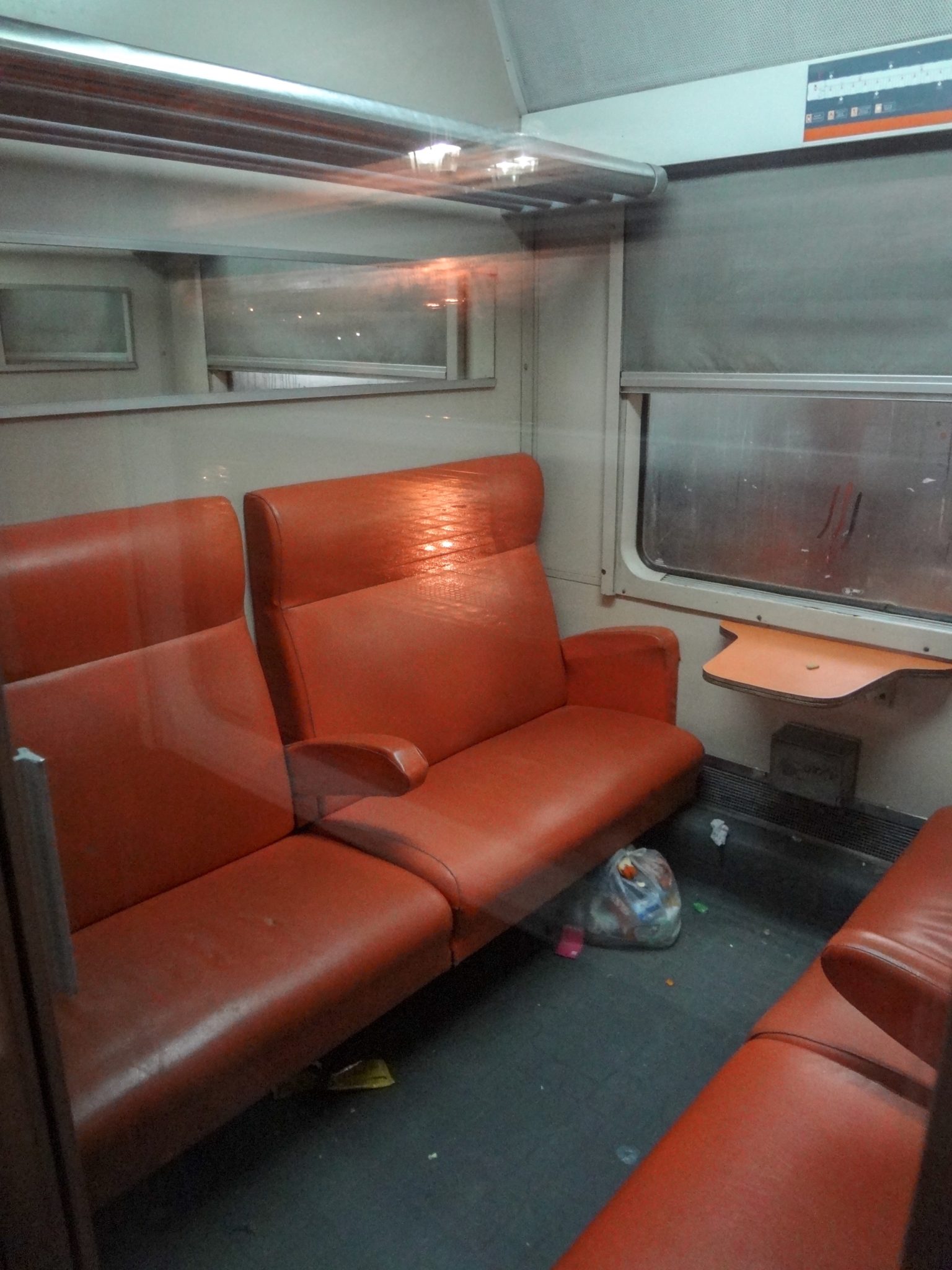
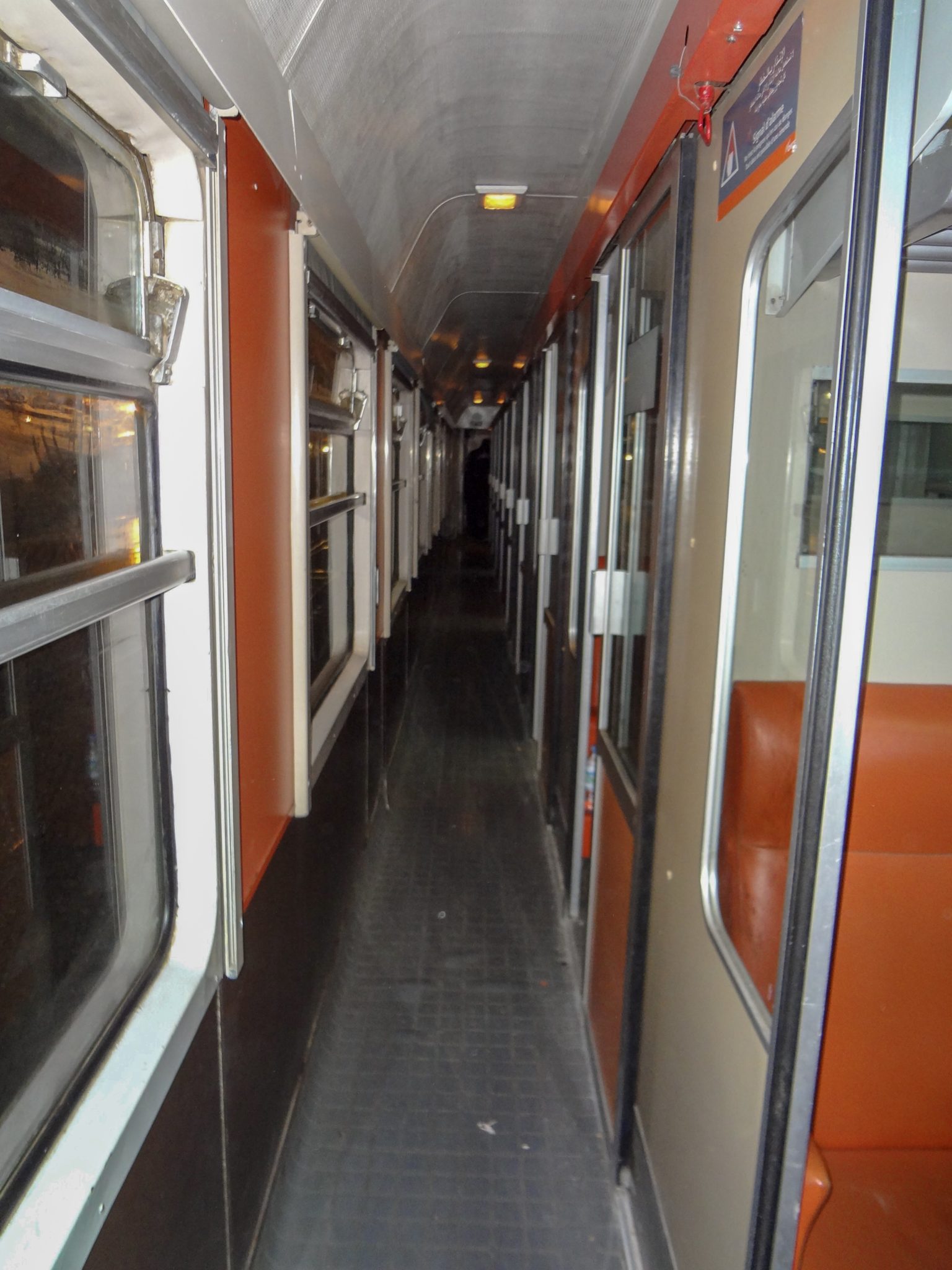
The train was the type that had separate cabins off a main corridor. We were lucky enough to get a cabin to ourselves for the three-hour journey.
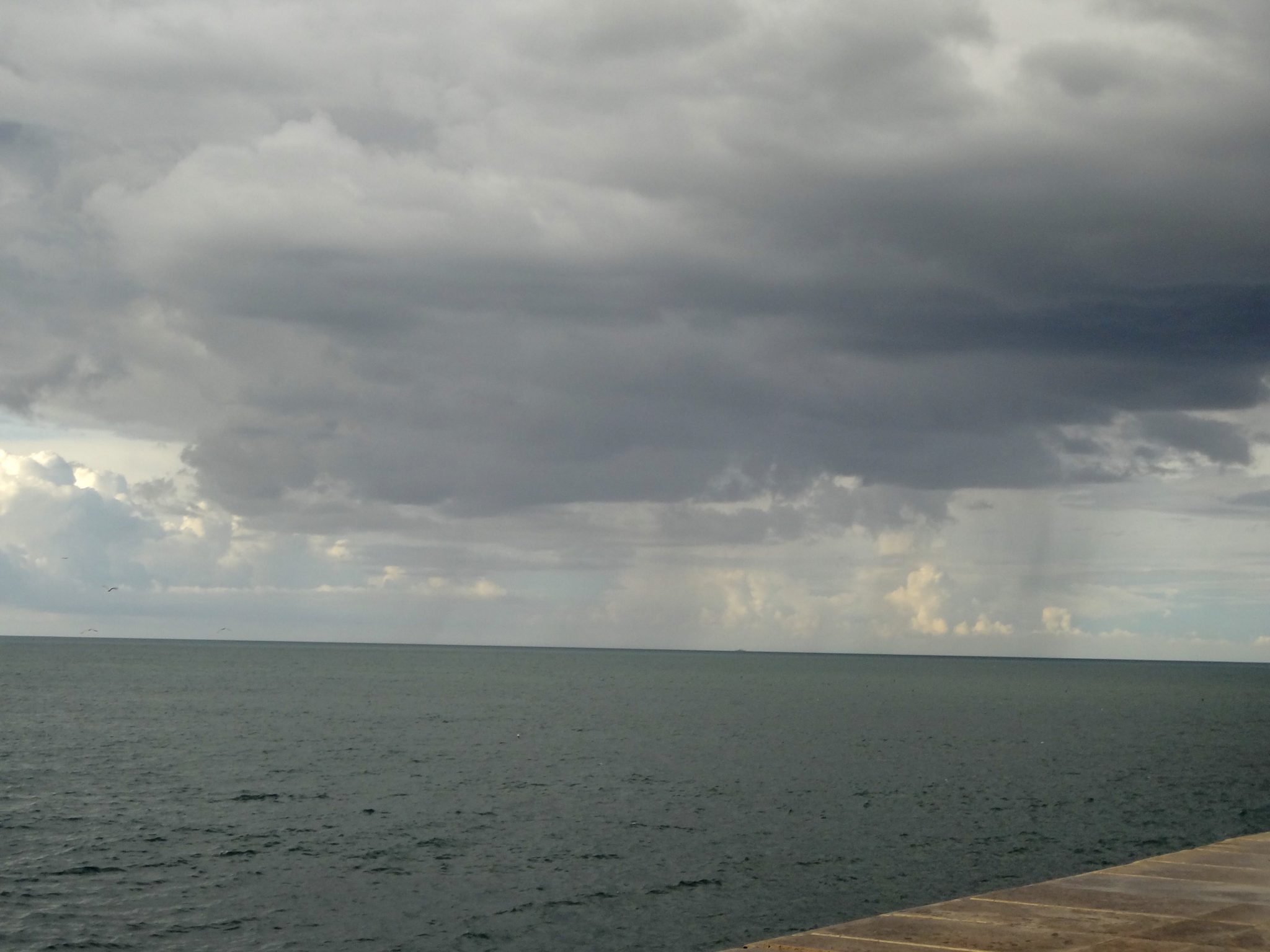
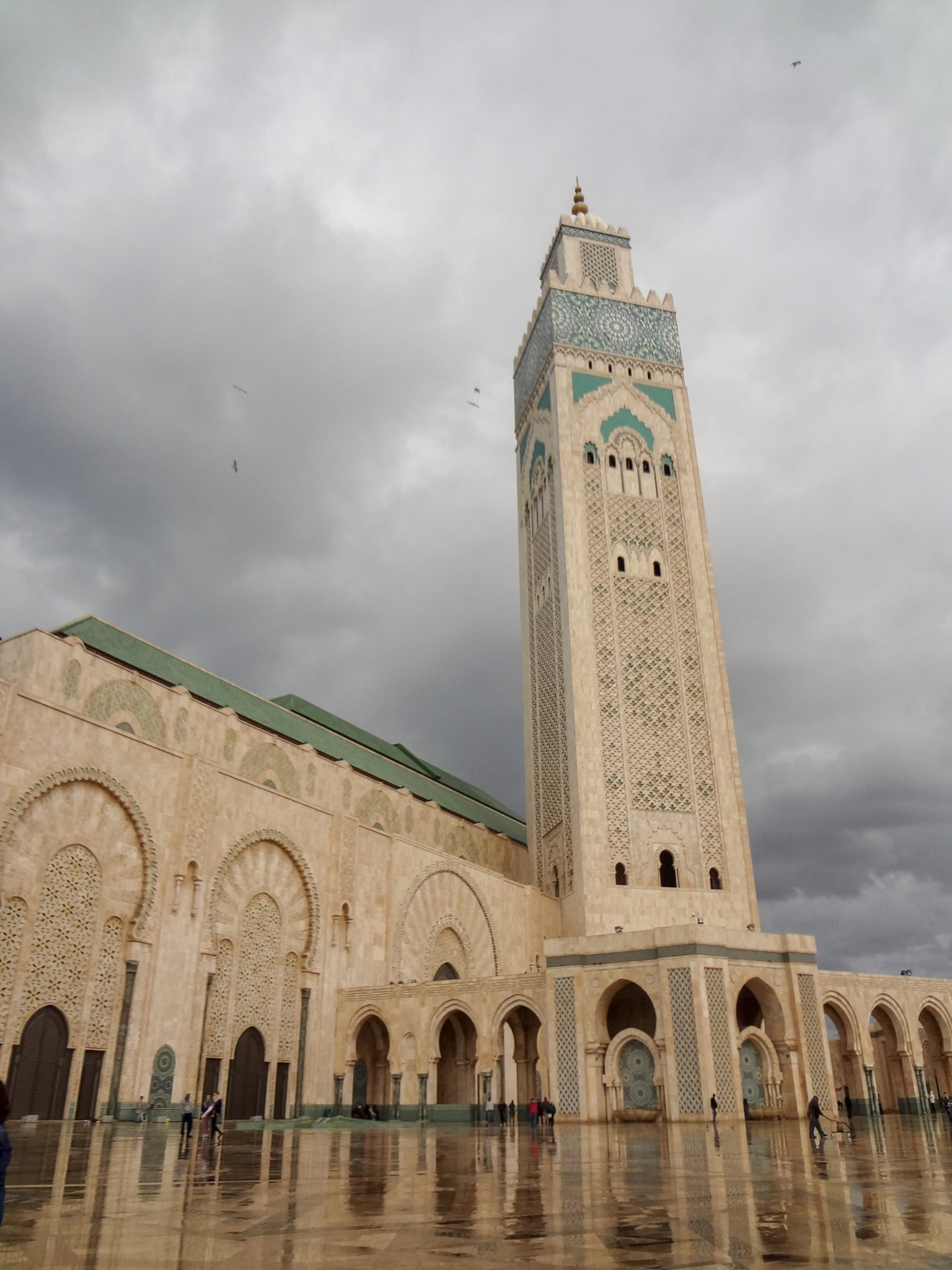
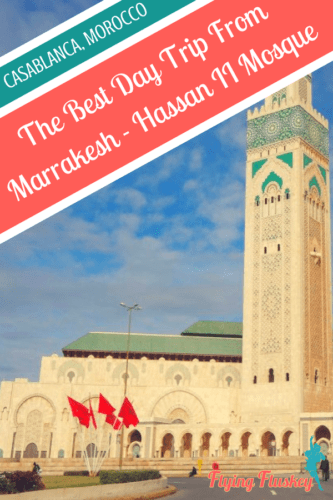
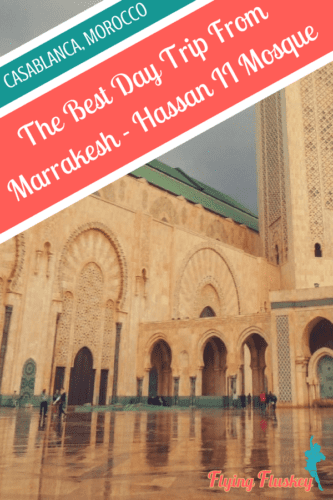
Hassan II Mosque sits overlooking the Atlantic Ocean. January set it against a grey and bitter sea but I bet it is glorious in the summer sun.
Glowering storm clouds
The Size
This mosque is BIG, that’s why it is called the Grande Mosque too. It is the second largest mosque in Africa, and fourteenth largest mosque in the world. I find that quite hard to believe as the place is HUGE. (At the time, it was the third largest, and that seemed about right. The world must be building some huge mosques!) It was so difficult to get a sense from across the road, but as we walked across the vast outside area it slowly loomed above us. Even in these photos I may struggle to give you an idea of scale.
The whole thing didn’t come cheap. It was the idea of the former King, but he wasn’t funding it. Instead, the Moroccan people had to fund a fair chunk. They were essentially subject to a Grand Mosque tax, payable by every family in the country; whether they intended to use the building or not. The total cost was over £500,000,000, but I suppose they really have something to show for it!
The Minaret
The minaret is the second largest in the world; standing at 210 metres. At night, a laser shines east from the top in the direction of Mecca. The giant doors at its base, by the main entrance to the mosque can be drawn all the way up.
The Prayer Hall
That’s not the only moving part to this gigantic building; the roof is retractable. That means that the 25,000 worshippers inside can enjoy the same Moroccan sunshine as the 80,000 people praying outside.
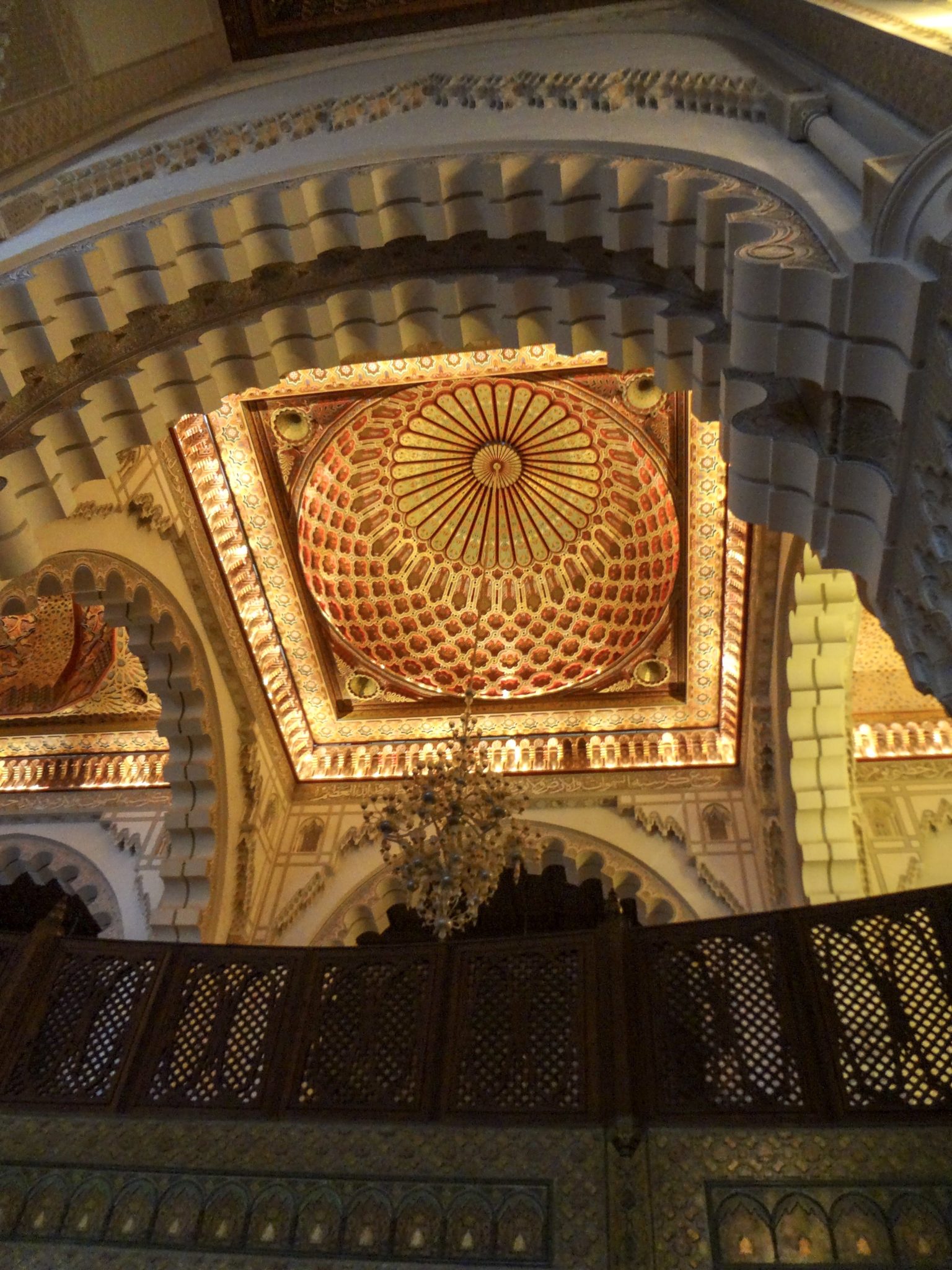
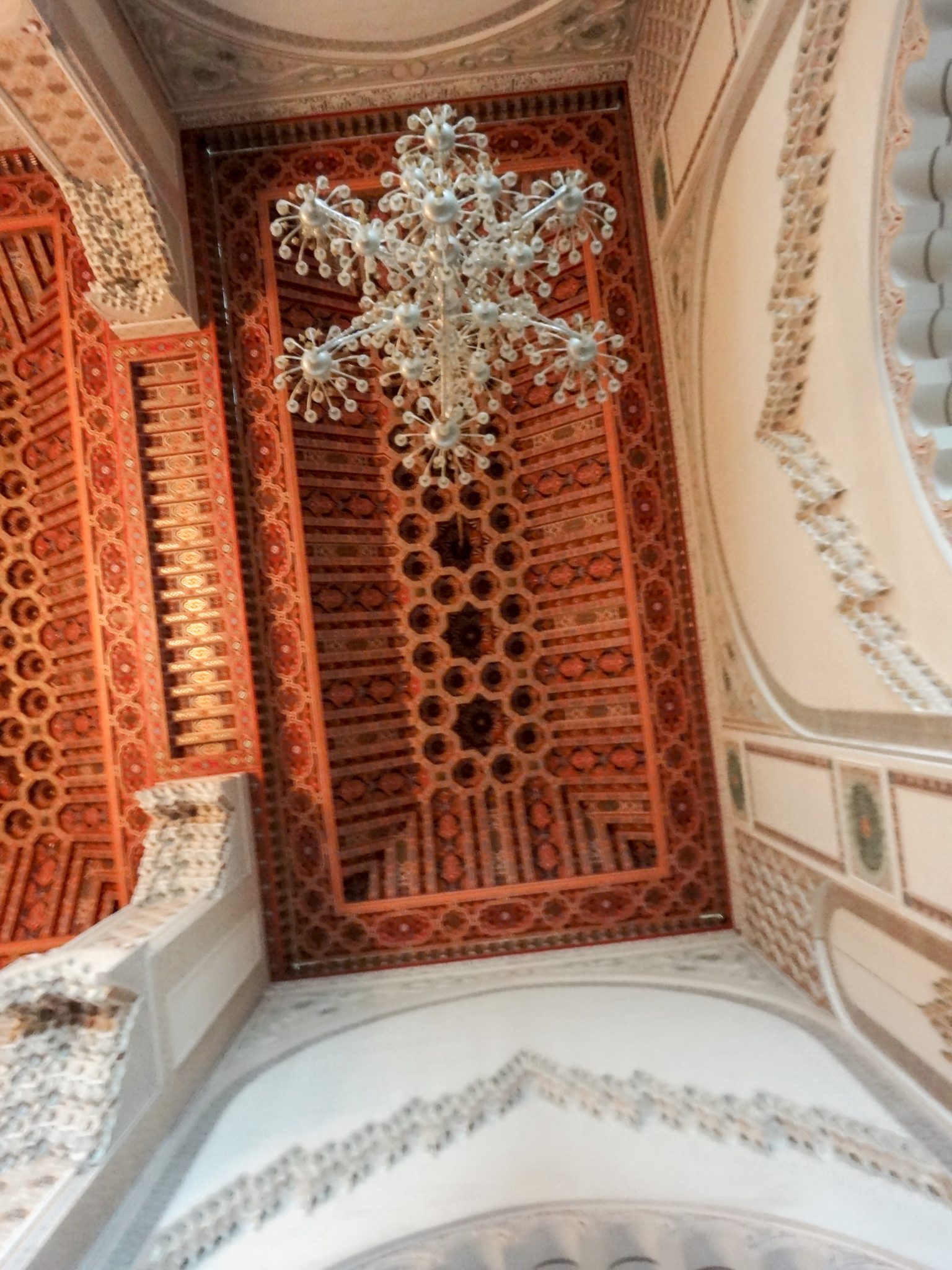
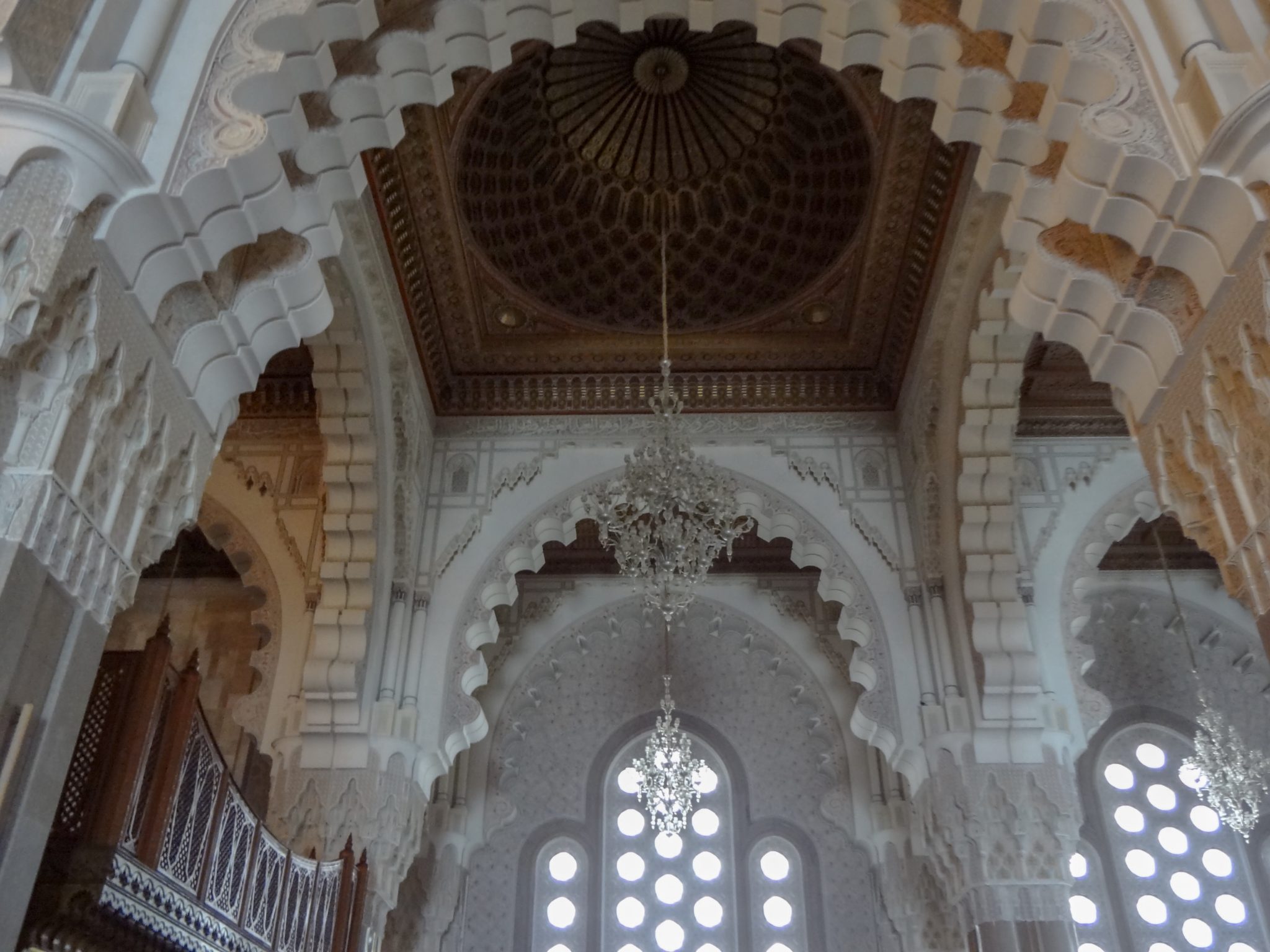
Our first stop was the prayer hall. This is 200 metres long, and half as wide. It’s like two full size football pitches laid end to end. The whole thing is intricately decorated with influences from traditional Moorish design, and more local tastes. As it was only built in the last decades of the 20th century, the whole thing is an homage to the mosques that had come before it. During construction there were around 10,000 craftsmen working on the building in shifts as large as 1400 people at a time.
Don’t forget to look upThere are naves to either side of this large prayer hall tooThe roof was amazing, and I love that snowflake-esque chandelier
The Downstairs
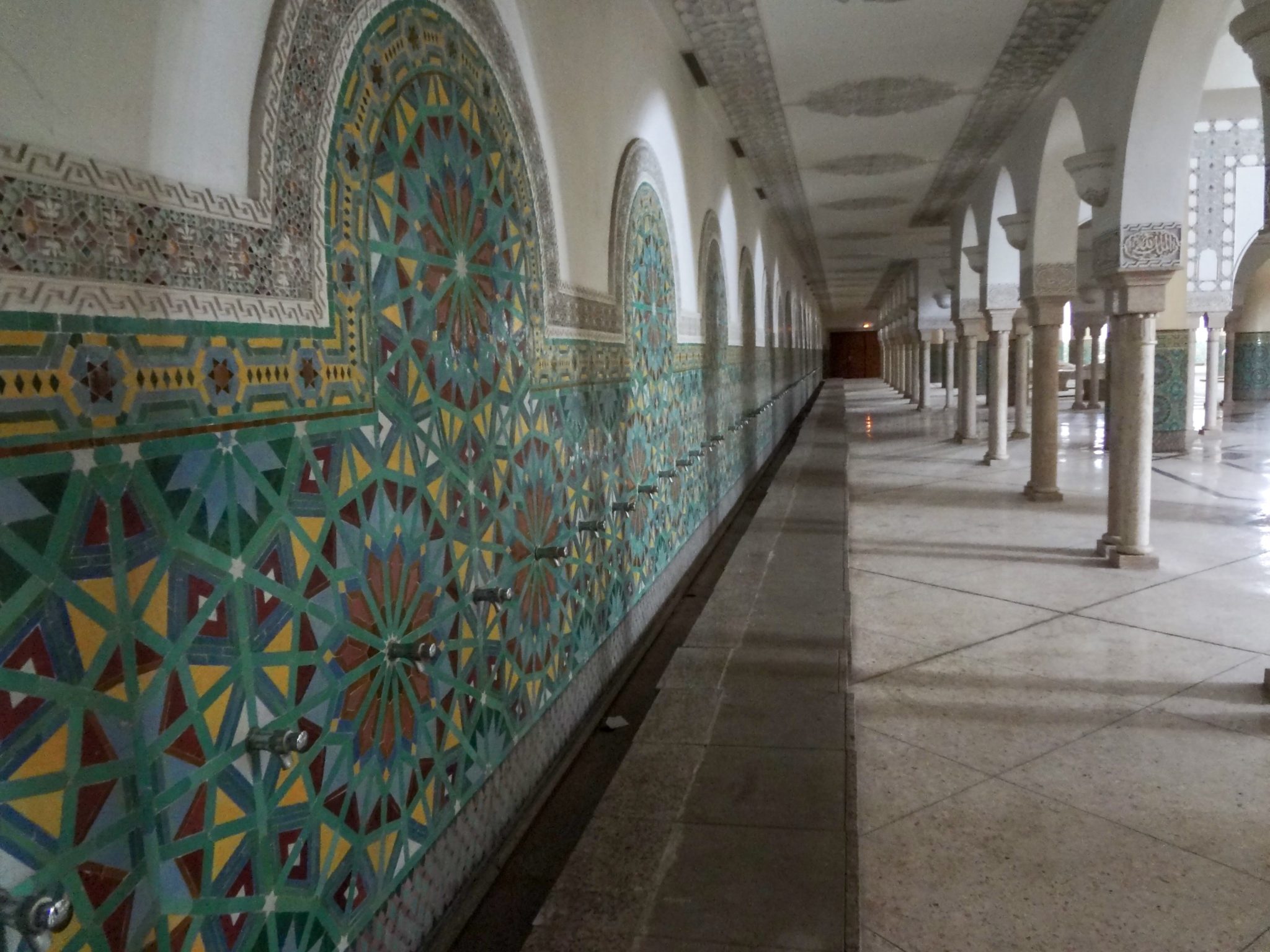
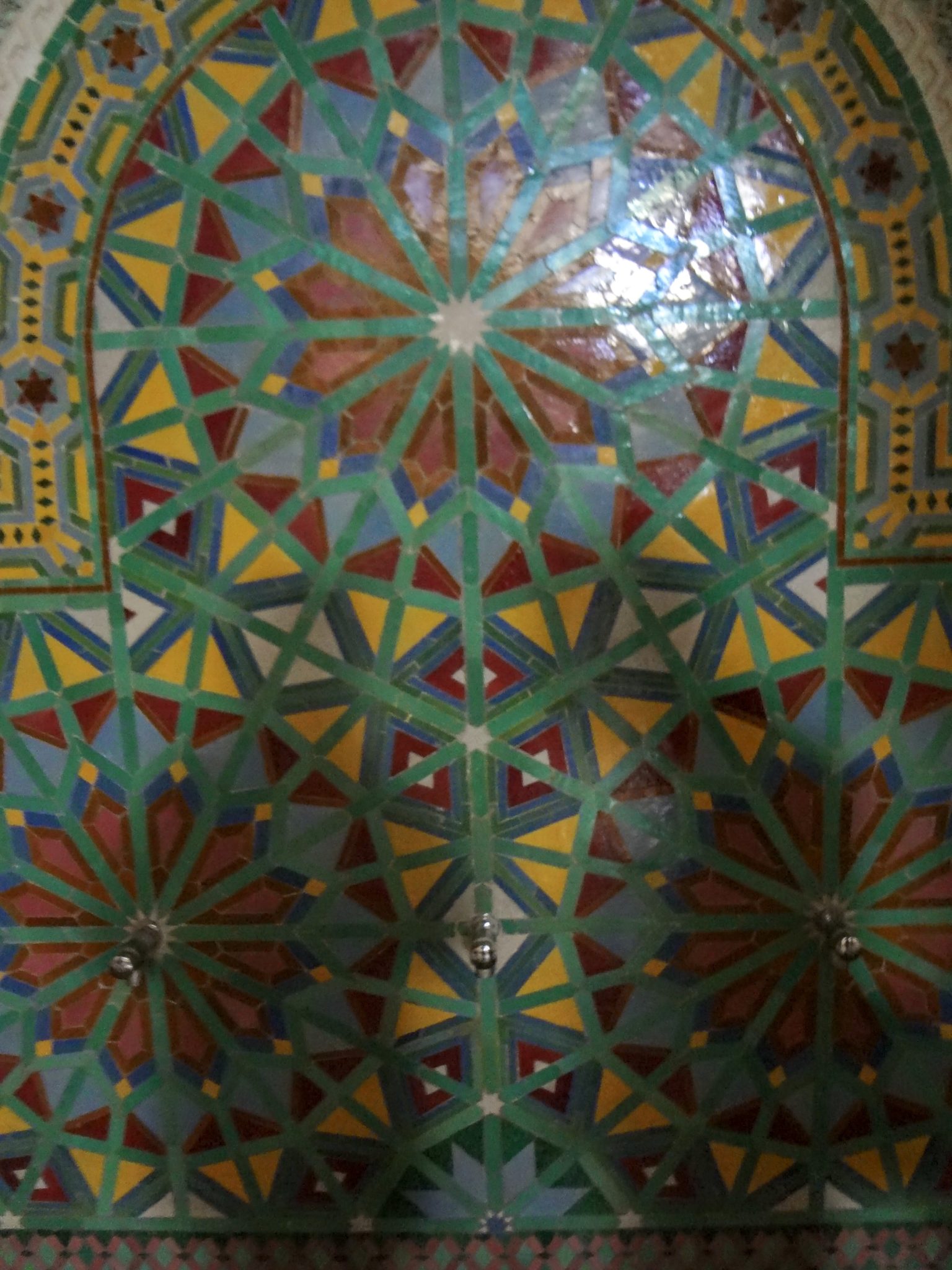
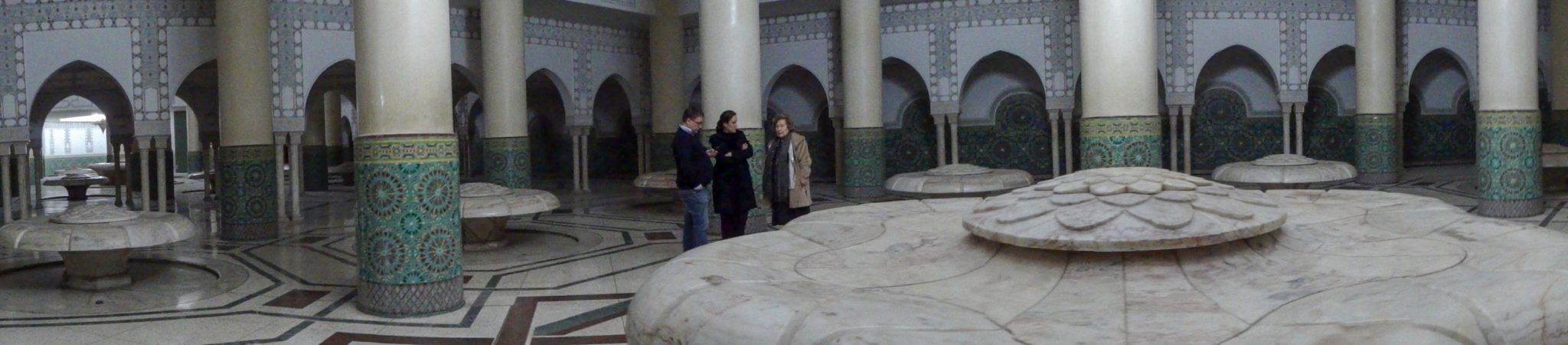
The ablutions room was my favourite area. It was symmetrical, tiled, Moroccan perfection. During our visit it was empty and echoed every footstep. I would love to see it full of the sounds of splashing fountains, gossiping friends and children screaming with delight or horror at the cold water.
That’s taps as far as the eye can seeSuch wonderful coloursThese fountains are designed to look like lotus flowers
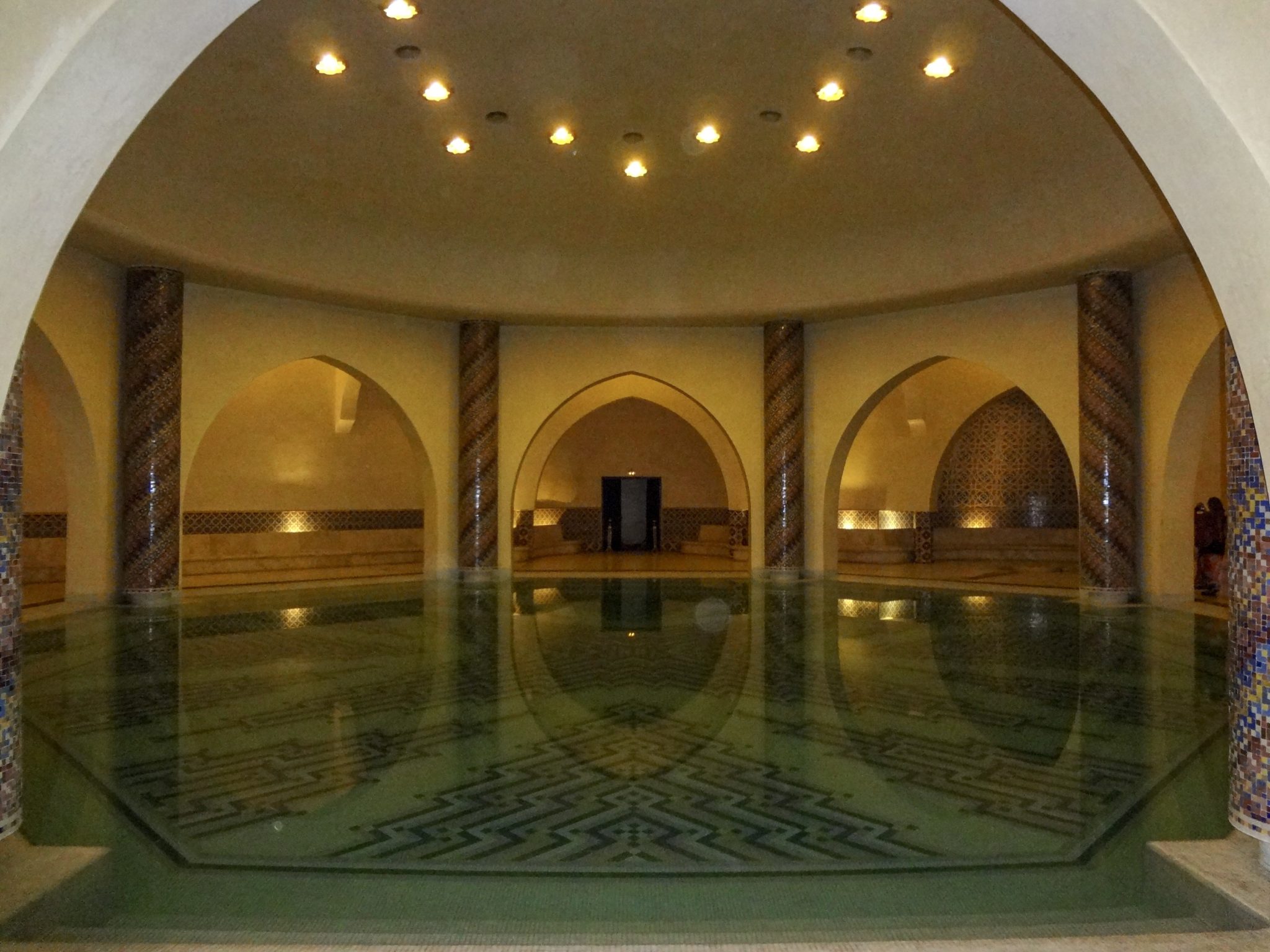
As well as the normal washing areas, the mosque has its very own hammam. Lots of sparkling rooms are crowned by a lovely heated pool. This pool is never used. It seems like a big waste, but I didn’t dare an illicit dip.
Why is Casablanca the Perfect Day Trip from Marrakesh?
Casablanca, as a city, is not that exciting. There is a small souk (market) but from what we saw, it was mostly places to buy socks and pants. The most intriguing thing we saw was two men drawing string along a wall. They had stretched it for thirty metres, zigzagging back and forth. We never found out what it was all about, and were sad that we didn’t ask.
Casablanca is the financial heart of Morocco. It has a lot more modernity and a lot less atmosphere. It certainly wasn’t the tropical, colonial place I had conjured up in my imagination. Hollywood really romanticised it for me.
This is why we thought it was the perfect day trip from Marrakesh. We saw the stunning Hassan II mosque, had a little wander, and then it was time to leave. We were glad that we could go back to Marrakesh, but so glad that we had visited. Feeling quite uninspired by the food options, and by Casablanca in general, we decided that this was the place to get Mr Fluskey’s customary Big Mac. After dinner, it was time to get the train back.
Obviously, we always encourage you to go and make your owns mind up!
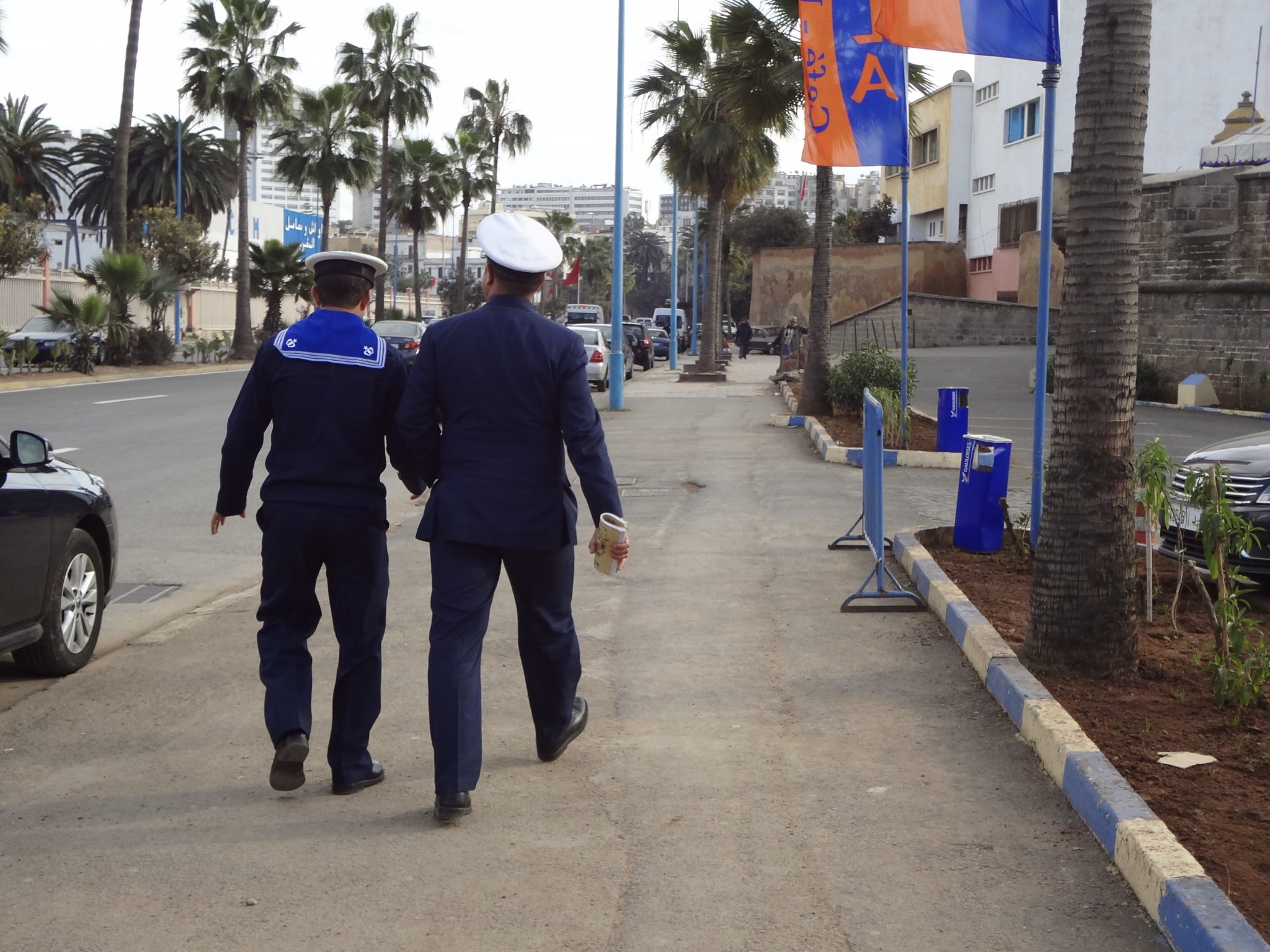
These jaunty chaps were a nice reminder that Casablanca is a port city.
The Train Home
On the way home, we were a lot less lucky with our cabin mates. It was very busy, and so we were squished in. An argument kicked off between two people, and the shouting went on for a while. We had no idea what was going on but luckily, it didn’t escalate. The plan was to have a little nap, but it was so busy that we just enjoyed observing the other people in the carriage.
If you are thinking of visiting Casablanca and Hassan II Mosque, here are some things you might need to know for your perfect day trip from Marrakesh.
Trains run every couple of hours between Marrakesh and Casablanca. Be sure to check the timetable before you go.
Hassan II mosque is a 20 minute walk from the station.
To enter the mosque, appropriate dress is required. Knees and arms should be covered but ladies don’t need to cover their hair. You will be asked to remove your shoes.
The mosque can only be visited as part of a tour. These are conducted in several different languages. To find out more information about this check out the website here.
Maybe if we’d had more time, we’d have discovered more in Casablanca to love. Honestly though, I was really glad that we weren’t staying overnight because we had seen its undisputed highlight.
Have you been to Casablanca? What did we miss? Let us know by leaving a comment.
Rosie xx
Love it? Pin it!
Love it? Pin it!
This website uses cookies to improve your experience. We'll assume you're ok with this, but you can opt-out if you wish.AcceptRejectRead More
Privacy & Cookies Policy
Privacy Overview
This website uses cookies to improve your experience while you navigate through the website. Out of these cookies, the cookies that are categorized as necessary are stored on your browser as they are essential for the working of basic functionalities of the website. We also use third-party cookies that help us analyze and understand how you use this website. These cookies will be stored in your browser only with your consent. You also have the option to opt-out of these cookies. But opting out of some of these cookies may have an effect on your browsing experience.
Necessary cookies are absolutely essential for the website to function properly. This category only includes cookies that ensures basic functionalities and security features of the website. These cookies do not store any personal information.
Any cookies that may not be particularly necessary for the website to function and is used specifically to collect user personal data via analytics, ads, other embedded contents are termed as non-necessary cookies. It is mandatory to procure user consent prior to running these cookies on your website.
Cookie Consent
We use cookies to improve your experience on our site. By using our site, you consent to cookies.
Contains information related to marketing campaigns of the user. These are shared with Google AdWords / Google Ads when the Google Ads and Google Analytics accounts are linked together.
90 days
__utma
ID used to identify users and sessions
2 years after last activity
__utmt
Used to monitor number of Google Analytics server requests
10 minutes
__utmb
Used to distinguish new sessions and visits. This cookie is set when the GA.js javascript library is loaded and there is no existing __utmb cookie. The cookie is updated every time data is sent to the Google Analytics server.
30 minutes after last activity
__utmc
Used only with old Urchin versions of Google Analytics and not with GA.js. Was used to distinguish between new sessions and visits at the end of a session.
End of session (browser)
__utmz
Contains information about the traffic source or campaign that directed user to the website. The cookie is set when the GA.js javascript is loaded and updated when data is sent to the Google Anaytics server
6 months after last activity
__utmv
Contains custom information set by the web developer via the _setCustomVar method in Google Analytics. This cookie is updated every time new data is sent to the Google Analytics server.
2 years after last activity
__utmx
Used to determine whether a user is included in an A / B or Multivariate test.
18 months
_ga
ID used to identify users
2 years
_gali
Used by Google Analytics to determine which links on a page are being clicked
30 seconds
_ga_
ID used to identify users
2 years
_gid
ID used to identify users for 24 hours after last activity
24 hours
_gat
Used to monitor number of Google Analytics server requests when using Google Tag Manager